Nicole Claire reviews her favorite recently published books that will help chase away the winter blues!
ALA Names Top Youth Books
The ALA announced the top books for 2014, and SAM & DAVE DIG A HOLE earned a Caldecott Honor! Check out the winners in all the categories
here –http://www.prnewswire.com/news-releases/american-library-association-announces-2015-youth-media-award-winners-300028995.html
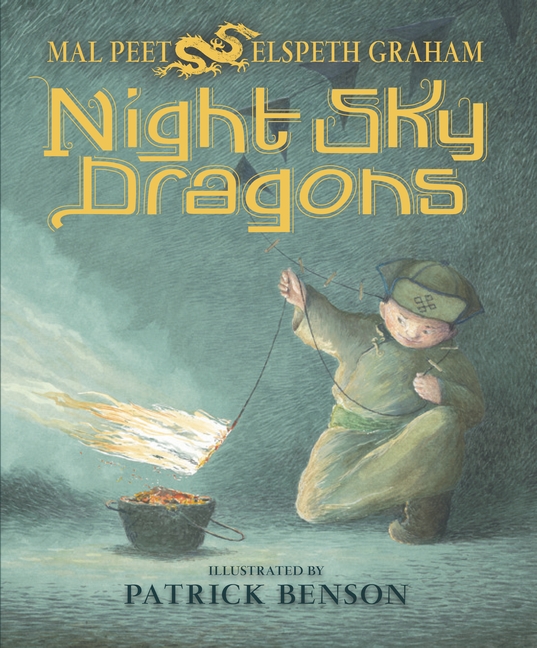
Night Sky Dragons, by Mal Peet & Elspeth Graham, illustrated by Patrick Benson; Candlewick Press, $15.99, 64 pages, ages 5-8.
Husband and wife team Mal Peet and Elspeth Graham (Mysterious Traveler; Cloud Tea Monkeys) share another story set in a far away place in another time. Yazul lives in a han, a walled roadside inn along the Silk Road, and his father is its lord. The young boy spends most of his days making kites with his grandfather, much to his father’s disapproval. But when bandits encircle the han, cutting off the inhabitants from fresh food and water, Yazul enlists his grandfather and his kite-making prowess to save the day. Tucked inside the special dragon kites is a secret weapon: Gunpowder, which, loaded into the kites’ bamboo stems, creates homemade firecrackers. Peet and Graham weave a spirited tale of adventure and cunning. Award-winning illustrator (Owl Babies; The Sea-Thing Child) Patrick Benson’s pen and watercolor illustrations are full of detail, and set the right tone for a thrilling story set in a faraway place. Expect this book to be in heavy reading rotation at bedtime.
Zig and the Magic Umbrella


(images used with permission from Dial Books; ©2015 Sylvie Kantorovitz)
Zig and the Magic Umbrella, by Sylvie Kantorovitz; Dial Press, $16.99, 32 pages, ages 2-5. (On Sale March 15, 2015)
We’re looking at another rain-themed book this week, and this time it’s Sylvie Kantorovitz’s latest read-aloud, Zig and the Magic Umbrella. A timid, suspender-wearing blue ogre wakes up to a dark and rainy day, but when he grabs a red umbrella flying by his window, Zig is carried away to a magical forest. There, he meets a frantic yellow bird who needs help freeing his flock from a mean monster’s lair, and Zig summons his courage to save the day. That red umbrella comes in handy too – it transforms into a bridge, a boat, a lever, and even a dart. Kantorovitz’s collage and acrylic illustrations stay in the primary color range but vary in tone, creating a warm and inviting imaginary world. Her use of color recalls the whimsical exuberance of fellow French illustrator Hervé Tullet. The story is just long enough for young readers, and really serves as backdrop to the wonderful art. In all, Zig’s adventure is a cute story that will encourage children to use their imaginations to create their own adventures on dreary days.


Blue on Blue, by Dianne White, illustrated by Beth Krommes; Beach Lane Books, $17.99, 48 pages, ages 2-5.
Thunderstorms have a powerful and sometimes frightening impact on young children, but Blue on Blue dispels some of that apprehension through rhyme and rhythm. Dianne White’s first childrens book describes the swell of an impending storm with minimal, well-chosen words. In fact, the text is so spare and the pacing so quick that I am surprised at the recommended age range, which is five to eight year olds. It is a perfect selection for toddlers, however – just long enough to keep little children entertained, and White’s word repetition reinforces key concepts. Caldecott Medal winner Beth Krommes’ (The House in the Night; Grandmother Winter) instantly recognizable scratchboard and watercolors of children splashing and jumping in puddles are full of rich detail and are a welcome celebration of rainstorms.
The Witch’s Boy
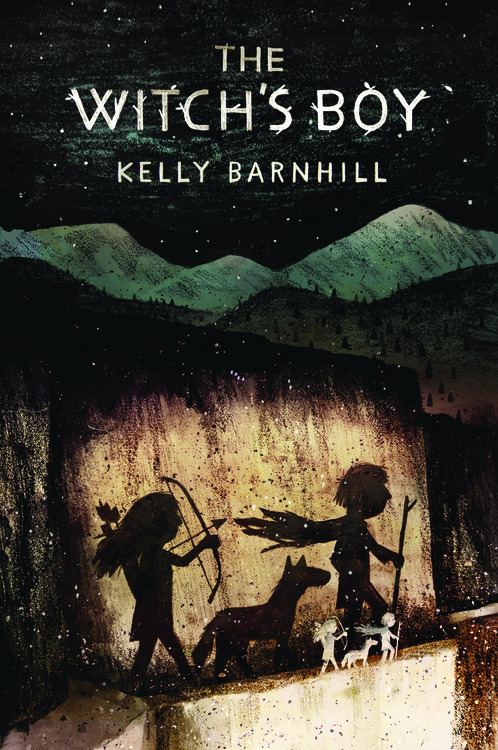
Kelly Barnhill spoke with me on a chilly, snow-covered day in November about her latest book, The Witch’s Boy. She talked about magic and danger in middle-grade literature, how children tackle parental substance abuse, and how those kids can beat the odds. Even though Barnhill was battling a fearsome cough during our conversation, her spirit and enthusiasm was warm and inspiring.
The Witch’s Boy feels like a recently unearthed tale by the Grimm brothers. It takes place in a faraway Celtic universe, where a Bandit King searches for magic protected by a witch. The witch has a son, Ned, the surviving twin of a tragic rafting accident which left him melancholic and with a debilitating stutter. In order to prevent war and save the magic from the Bandit King, Ned must find his courage and inner strength. At first glance, he does not possess typical heroic traits. He is small and uninspiring, with a stutter to boot. Nevertheless, Ned takes up the mantle, and his sidekicks include a wolf and a young girl named Àine, (pronounced Anya) whose father, the Bandit King, becomes more obsessed with obtaining the magic as he nears it. Danger faces the children at every turn as they rely on each other to survive and bring peace to their world. It’s not clear the pair will succeed, and they suffer throughout their journey – in a pivotal early moment, Ned saves the magic from the Bandit King by commanding it to reside within him, causing his skin to burn and turn blue. Àine is torn between her distant father and Ned, and fears she may have to kill her traveling companion if forced to choose between the two. The jacket art shows the travelers in silhouette, with the girl aiming an arrow at the back of unsuspecting Ned’s head.
Barnhill was a teacher before becoming a full-time writer, and the experience provided much literary grist. She taught middle school, then worked in the basement classroom of a drop-in center for homeless youth in Minneapolis. Students often came from fragmented families, were victims of abuse and neglect, and others were unable to read at their grade level. Barnhill told me that addiction was a recurring theme in many children’s lives. “When I taught in highly stressed out communities, parental addiction was a big issue. A lot of kids were in foster care, and their parents could not get their lives together, partly because they were enslaved by their own addictions.”
While adults may recognize a foster home as providing a safer environment, children often cannot let go of their parents, and Barnhill found that many would have preferred to stay and endure alongside them. Children have an amazing ability to pick up on the smallest things, then internalize and misinterpret their meanings; blaming themselves for their parents’ addictions, for example. In The Witch’s Boy, Barnhill illustrates how addiction is dangerous not just to those powerless to overcome it, but to loved ones relegated to the sidelines. “People love their addiction and they do love their child. But they love their addiction more, which creates an interesting dynamic,” she said. The Bandit King loves his child, and he loved Àine’s mother too – so much that, for a time, he was able to leave magic behind. But with the death of his beloved wife, he reverts. “This happens with grief in real life,” said Barnhill. “People resume that addictive behavior, and all of the bad choices and disruption comes swooping back.”
Despite the overwhelming disadvantages that homeless children face, Barnhill found the experience thoroughly rewarding and that the children in her program were motivated to succeed. “It was an amazing job because the stats for homeless youth are so terrible,” she said. “I was the drop in teacher at this center where kids could come and be safe. Homeless kids can be skittish. It was a safe place with food and doctors, social workers and then there I was, filling in the gaps of their education.” Some of those children really big gaps, but because they were choosing to come to the center, they were more likely to beat the statistics stacked against them. Many of Barnhill’s students got their GEDS, and she helped others with their college applications and FAFSA requirements.
There’s no lack of violence in Barnhill’s book, and the children bear the consequences of their parents’ choices. Within all the cruelty and harm that befalls Ned and Àine, those are authentic, teachable moments. Barnhill considers her work and the work of other children’s book authors as crucial in shaping young minds. “Children’s book authors have a bit of the evangelist in them. We are all profound believers in children’s literacy and in the power of books for children.”
Developing empathy and an understanding of one’s place in the world requires reading powerful, moving stories. Barnhill’s book is not escapist literature, nor is it an exercise in descriptive horror. Rather, its allow critical examination of societies where danger is ever-present. Children may take some comfort in reading them, but the story is frightening – the fate of an entire community rests on the shoulders of youth. Still, the experience of childhood is full of anxiety, and this book offers children the tools to navigate the complexities of the world.
So many middle middle grade books are all violence and no plot, or are overly saccarine and dull, but in The Witch’s Boy, no one is perfect the characters’ personalities change. “Human beings are complicated,” Barnhill said. “I never wanted to write a good against evil story because it’s not true. Look at human history – you don’t see good triumphing over evil, it’s people making conscious choices to make good decisions. Just because a good side wins, it’s not the end of the story. The victors have to make good decisions after the war is over.”
While it seemed the book was written in such as way that a sequel isn’t out of the question, Barnhill wasn’t too sure it needed one. “I like stand-alones. The sequel is written on the heart of the reader. I have no intention to write a sequel right now because I’ve left my characters in a good place.” Barnhill’s working another fantasy called The Girl Who Drank the Moon, and she’s also writing a libretto – Minnesota opera adapted her work as an opera for children, and will be sung by children.
The Witch’s Boy, by Kelly Barnhill; Algonquin Books for Young Readers, $16.95, 384 pages, ages 11-14.
Winter Sparks


©2015 Deirdre Gill
Outside, by Deirdre Gill; Houghton Mifflin Harcourt, $16.99, 40 pages, ages 2-5.
What’s a boy to do when his older brother won’t join him in wintery fun outdoors? In author-illustrator Deirdre Gill’s charming picture book debut, the child ventures out alone, and builds a grand, icy fantasy world. After constructing a castle, a gentle snowman and a fire-breathing dragon, he embarks on wondrous imaginary adventures. Gill’s large oils on paper are inviting and, despite large swaths of snow covering most pages, warm. The text is minimal, but sonorous and spare enough for young readers to follow along with ease, and adult readers may notice the subtle homage to Ezra Jack Keats 1962 Caldecott winner The Snowy Day. The plucky protagonist’s imagination will likely provide inspiration to readers who find themselves staring out their own windows this winter, wondering what happens when they take that first step.

literarykids: Correction: Antony uses graphite pencils, not pen and ink.
Please, Mr. Panda, by Steve Antony; Scholastic Press, $16.99, 32 pages, ages 2-6.
Etiquette gets a furry makeover in this good-natured primer on proper behavior. British artist Steve Antony (Betty Goes Bananas; The Queen’s Hat) returns to the world of picture books with a surprisingly generous, yet straight-lipped panda, who patiently surveys his animal friends to see if they would like a doughnut. While most jump at the chance to savor a sugary confection, they do not employ the magic words, and the panda reneges on his offer until someone asks him politely. All the animals are rendered with graphite pencils in bold strokes of black and white, and the bright pink, red and purple colored doughnuts pop off the page. The recurring dialogue makes this a wonderfully fun and engaging read-aloud, and children just on the cusp of independent reading might even be tempted to decipher the words on their own.

Please, Mr. Panda, by Steve Antony; Scholastic Press, $16.99, 32 pages, ages 2-6.
Etiquette gets a furry makeover in this good-natured primer on proper behavior. British artist Steve Antony (Betty Goes Bananas; The Queen’s Hat) returns to the world of picture books with a surprisingly generous, yet straight-lipped panda, who patiently surveys his animal friends to see if they would like a doughnut. While most jump at the chance to savor a sugary confection, they do not employ the magic words, and the panda reneges on his offer until someone asks him politely. All the animals are rendered with graphite pencils in bold strokes of black and white, and the bright pink, red and purple colored doughnuts pop off the page. The recurring dialogue makes this a wonderfully fun and engaging read-aloud, and children just on the cusp of independent reading might even be tempted to decipher the words on their own.
 Literary Features Syndicate