The Witch’s Boy

image

Kelly Barnhill spoke with me on a chilly, snow-covered day in November about her  latest book, The Witch’s Boy. She talked about magic and danger in middle-grade literature, how children tackle parental substance abuse, and how those kids can beat the odds. Even though Barnhill was battling a fearsome cough during our conversation, her spirit and enthusiasm was warm and inspiring.

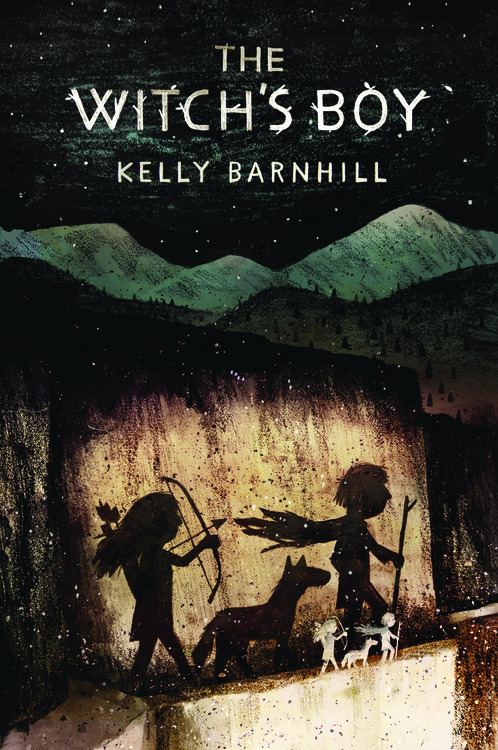
The Witch’s Boy feels like a recently unearthed tale by the Grimm brothers. It takes place in a faraway Celtic universe, where a Bandit King searches for magic protected by a witch. The witch has a son, Ned, the surviving twin of a tragic rafting accident which left him melancholic and with a debilitating stutter. In order to prevent war and save the magic from the Bandit King, Ned must find his courage and inner strength. At first glance, he does not possess typical heroic traits. He is small and uninspiring, with a stutter to boot. Nevertheless, Ned takes up the mantle, and his sidekicks include a wolf and a young girl named Àine, (pronounced Anya) whose father, the Bandit King, becomes more obsessed with obtaining the magic as he nears it.  Danger faces the children at every turn as they rely on each other to survive and bring peace to their world.  It’s not clear the pair will succeed, and they suffer throughout their journey – in a pivotal early moment, Ned saves the magic from the Bandit King by commanding it to reside within him, causing his skin to burn and turn blue. Àine is torn between her distant father and Ned, and fears she may have to kill her traveling companion if forced to choose between the two. The jacket art shows the travelers in silhouette, with the girl aiming an arrow at the back of unsuspecting Ned’s head.

Barnhill was a teacher before becoming a full-time writer, and the experience provided much literary grist. She taught middle school, then worked in the basement classroom of a drop-in center for homeless youth in Minneapolis. Students often came from fragmented families, were victims of abuse and neglect, and others were unable to read at their grade level. Barnhill told me that addiction was a recurring theme in many children’s lives. “When I taught in highly stressed out communities, parental addiction was a big issue. A lot of kids were in foster care, and their parents could not get their lives together, partly because they were enslaved by their own addictions.”

While adults may recognize a foster home as providing a safer environment, children often cannot let go of their parents, and Barnhill found that many would have preferred to stay and endure alongside them. Children have an amazing ability to pick up on the smallest things, then internalize and misinterpret their meanings; blaming themselves for their parents’ addictions, for example.  In The Witch’s Boy, Barnhill illustrates how addiction is dangerous not just to those powerless to overcome it, but to loved ones relegated to the sidelines. “People love their addiction and they do love their child. But they love their addiction more, which creates an interesting dynamic,” she said. The Bandit King loves his child, and he loved Àine’s mother too – so much that, for a time, he was able to leave magic behind.  But with the death of his beloved wife, he reverts. “This happens with grief in real life,” said Barnhill. “People resume that addictive behavior, and all of the bad choices and disruption comes swooping back.”

Despite the overwhelming disadvantages that homeless children face, Barnhill found the experience thoroughly rewarding and that the children in her program were motivated to succeed. “It was an amazing job because the stats for homeless youth are so terrible,” she said. “I was the drop in teacher at this center where kids could come and be safe. Homeless kids can be skittish. It was a safe place with food and doctors, social workers and then there I was, filling in the gaps of their education.” Some of those children really big gaps, but because they were choosing to come to the center, they were more likely to beat the statistics stacked against them. Many of Barnhill’s students got their GEDS, and she helped others with their college applications and FAFSA requirements.

There’s no lack of violence in Barnhill’s book, and the children bear the consequences of their parents’ choices. Within all the cruelty and harm that befalls Ned and Àine, those are authentic, teachable moments. Barnhill considers her work and the work of other children’s book authors as crucial in shaping young minds. “Children’s book authors have a bit of the evangelist in them. We are all profound believers in children’s literacy and in the power of books for children.”

Developing empathy and an understanding of one’s place in the world requires reading powerful, moving stories.  Barnhill’s book is not escapist literature, nor is it an exercise in descriptive horror. Rather, its allow critical examination of societies where danger is ever-present. Children may take some comfort in reading them, but the story is frightening – the fate of an entire community rests on the shoulders of youth. Still, the experience of childhood is full of anxiety, and this book offers children the tools to navigate the complexities of the world.

So many middle middle grade books are all violence and no plot, or are overly saccarine and dull, but in The Witch’s Boy, no one is perfect the characters’ personalities change. “Human beings are complicated,” Barnhill said. “I never wanted to write a good against evil story because it’s not true. Look at human history – you don’t see good triumphing over evil, it’s  people making conscious choices to make good decisions. Just because a good side wins, it’s not the end of the story. The victors have to make good decisions after the war is over.”

While it seemed the book was written in such as way that a sequel isn’t out of the question, Barnhill wasn’t too sure it needed one. “I like stand-alones. The sequel is written on the heart of the reader. I have no intention to write a sequel right now because I’ve left my characters in a good place.”  Barnhill’s working another fantasy called The Girl Who Drank the Moon, and she’s also writing a libretto – Minnesota opera adapted her work as an opera for children, and will be sung by children.

The Witch’s Boy, by Kelly Barnhill; Algonquin Books for Young Readers, $16.95, 384 pages, ages 11-14.

Winter Sparks

©2015 Deirdre Gill

Outside, by Deirdre Gill; Houghton Mifflin Harcourt, $16.99, 40 pages, ages 2-5.

What’s a boy to do when his older brother won’t join him in wintery fun outdoors? In author-illustrator Deirdre Gill’s charming picture book debut, the child ventures out alone, and builds a grand, icy fantasy world. After constructing a castle, a gentle snowman and a fire-breathing dragon, he embarks on wondrous imaginary adventures. Gill’s large oils on paper are inviting and, despite large swaths of snow covering most pages, warm. The text is minimal, but sonorous and spare enough for young readers to follow along with ease, and adult readers may notice the subtle homage to Ezra Jack Keats 1962 Caldecott winner The Snowy Day. The plucky protagonist’s imagination will likely provide inspiration to readers who find themselves staring out their own windows this winter, wondering what happens when they take that first step.

literarykids: Correction: Antony uses graphite pencils, not pen and ink.

Please, Mr. Panda, by Steve Antony; Scholastic Press, $16.99, 32 pages, ages 2-6.


Etiquette gets a furry makeover in this good-natured primer on proper behavior. British artist Steve Antony (Betty Goes Bananas; The Queen’s Hat) returns to the world of picture books with a surprisingly generous, yet straight-lipped panda, who patiently surveys his animal friends to see if they would like a doughnut. While most jump at the chance to savor a sugary confection, they do not employ the magic words, and the panda reneges on his offer until someone asks him politely. All the animals are rendered with graphite pencils in bold strokes of black and white, and the bright pink, red and purple colored doughnuts pop off the page.  The recurring dialogue makes this a wonderfully fun and engaging read-aloud, and children just on the cusp of independent reading might even be tempted to decipher the words on their own. 

Please, Mr. Panda, by Steve Antony; Scholastic Press, $16.99, 32 pages, ages 2-6.


Etiquette gets a furry makeover in this good-natured primer on proper behavior. British artist Steve Antony (Betty Goes Bananas; The Queen’s Hat) returns to the world of picture books with a surprisingly generous, yet straight-lipped panda, who patiently surveys his animal friends to see if they would like a doughnut. While most jump at the chance to savor a sugary confection, they do not employ the magic words, and the panda reneges on his offer until someone asks him politely. All the animals are rendered with graphite pencils in bold strokes of black and white, and the bright pink, red and purple colored doughnuts pop off the page.  The recurring dialogue makes this a wonderfully fun and engaging read-aloud, and children just on the cusp of independent reading might even be tempted to decipher the words on their own. 

Nicole Claire looks at a collection of short stories for young adult readers.

My True Love Gave to Me, edited by Stephanie Perkins; St. Martin’s Press, $18.99, 321 pages, ages 12 and up.

My True Love Gave To Me (General Overview) 12-20-2014.mov

Check out Laura McPhee’s The Home and The World, published by Yale University Press, on the Fine Books Blog 

The Dragon & the Knight: A Pop-up Misadventure, by Robert Sabuda; Little Simon, $29.99, 22 pages, ages 5-up.

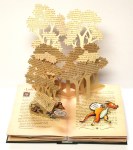
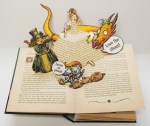
Master paper engineer Robert Sabuda has created another book sculpture for pop-up enthusiasts of all ages. In this volume of fractured fairytales, a brave (if slightly goofy) knight pursues a maligned and misunderstood dragon.  The duo escape from their story and onto the pages of other fairytales, ranging from Aladdin to Cinderella. The escapees wreak havoc on each tale they visit, while each page reveals a more complex and imaginative three-dimensional creation than the last.  While there is text on each page, it’s not really here to be read. Rather,  it demonstrates the ruckus caused by the intruders – fairytales are obscured by towering structures of fire-breathing dragons, and even some of the characters pop-up sheathed in outfits made of words. (See Cinderella’s dress and Aladdin’s flying carpet.) Sabuda paper art books makes stunning gifts, but they are delicate – with so many intricate folds and pleats, very young readers should be supervised, lest older readers wish to spend hours carefully refolding dragon tails and towers. This tour de force will make an excellent addition to any collection on paper engineering.

Full Speed Ahead! How Fast Things Go, by Crushiform; Abrams Books for Young Readers, $18.95, 64 pages, ages 4-8.

This bright and zippy book compares the speed of movement for various animals and transportation. For example, at 50km/h (30 mph,) a blue whale coasts along at the same rate as a cargo ship, while the Apollo 11 spacecraft cruises alone at 40,000km/h (25,000 mph). In each spread, the rate of speed is given in huge type on the left, and is accompanied by an equally bold image on the right, and the rate of speed increases incrementally. (The speed is given first in kilometers, then in miles per hour in slightly smaller size.)  Originally published in French under the title À Toute Vitesse, Parisian-based Cruschiform studios created the bold illustrations using spot color printing technique. Similar to screen painting, spot color printing was used by artists in the 1950s to reproduce images, and here, the bold colors and retro illustrations are eye-catching and easily accessible to young readers. The glossary includes further information about the moving objects, as well as a definition of speed. It is a perfect introductory picture dictionary for little speedsters.  Onward and upward. 

The Winter Train, by Susanna Isern, illustrated by Ester Garcia; Cuento de Luz, $16.95, 24 pages, ages 2-5. 

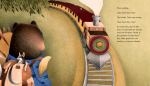
The first snowflakes send many of us for warmer climes, and the animals in The Winter Train are no exception. The Northern Forest inhabitants prepare to escape the annual freeze, packing their toothbrushes and turning out the lights. It seems everyone makes it onto the train, except they’ve forgotten their pal Squirrel. Friends stick together in Susanna Isern’s tale full of grace and solidarity, while Jon Brokenbow’s faithful translation retains the sonorous, read-aloud quality from the original Spanish version, Tren de invierno. Ester Garcia’s renderings of partriges, hedgehogs and ferrets are cozy and endearing. As these animals of the Northern Forest know, kindness and generosity are the nicest gifts of all.

Won’t You Break Your Lock and Key?

image

image credit: Bill Bragg

image

The Warden, by Anthony Trollope; The Folio Society, $53.95, 224 pages.

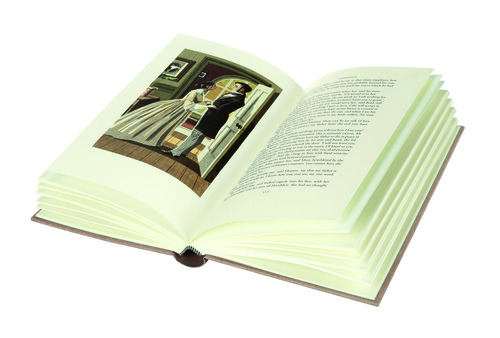
Since 1947, the Folio Society, a London-based publishing house, has offered exquisitely crafted volumes of the world’s greatest literature. Their edition of Anthony Trollope’s masterpiece The Warden is no exception – sheathed in a chestnut clamshell case, the clothbound volume includes appropriately dark, mysterious and complex illustrations by British artist Bill Bragg.  Pulitizer Prize winning author Jane Smiley provides readers with a nuanced examination of the author, as well as the world that influenced The Warden and other books in the Barsetshire Chronicles series.  Two major characters in English fiction both first appear here; Mr. Harding, the elderly warden of Hiram’s Hospital and the Rabelais-reading Archdeacon Grantly. Through their activities and relationships, Trollope keenly examines Victorian politics, society, and culture. Consider The Warden as an unexpected alternative to the traditional Dickensian offering this holiday season.

Folio FYI: You can’t get these books on Amazon. To ensure delivery by Christmas, the Folio Society requests orders to be placed by December 10th.