2014 Newbery and Caldecott Winners

The American Library Association announced the winners of the 2014 Newbery and Caldecott medals on Monday.   A panel of fifteen librarians from across the country gathered to honor the very best children’s books.  What distinguishes the two awards? The Newbery Medal goes to the author of “the most distinguished contribution to American literature for children.”   The Caldecott recognizes an artist’s excellence in picture book illustration.  Here they are:

 “Flora and Ulysses: The Illustrated Series,by Kate DeCamillo, illustrated by K.G. Campbell; Candlewick Press, $17.99, 240 pages, ages 9-12.

In this adorable ode to superheroes, comic-book aficionado Flora sets on a series of adventures with a witty squirrel appropriately named Ulysses. DeCamillo’s humor (and wonderfully rich vocabulary) is perfectly matched by comic book artist’s K.G. Campbell’s black and white illustrations.  Readers will adore that this quirky action-packed novel matches a sensitive, sophisticated story.


Honor Books:

“Doll Bones,” by Holly Black; Margaret K. McElderry Books, $16.99, 256 pages, ages 10-14.

“The Year of Billy Miller,” by Kevin Henkes; Greenwillow Books, $16.99, 240 pages, ages 8-13.

“One Came Home,by Amy Timberlake; Alfred A. Knopf, $16.99, 272 pages, ages 9-13.

“Paperboy,by Vince Vawter; Delacorte Press, $16.99, 240 pages, ages 10-14.

Caldecott Medal Winner:

“Locomotive,” by Brian Floca; Atheneum Books for Young Readers, $17.99, 64 pages, ages 4-10. 

This year’s Caldecott winner is a picture book rich with sensory details about America’s first trans-continental railroad.  The rolling text mimics the turning of the wheels and the rumbling of the train down the track.  Sumptuous images will easily captivate young readers, despite the book’s length. 


Honor Books:

Journey,” by Aaron Becker; Candlewick Press, $15.99, 40 pages, ages 4-8.

“Flora and the Flamingo,” by Molly Idle; Chronicle Books, $16.99. 44 pages, ages 4-8.

“Mr. Wuffles!”  by David Wiesner; Clarion Books, $17.99, 32 pages, all ages.

MANHATTAN – The Little Prince is most often associated with the City of Lights.  Yet Antoine de Saint-Exupéry’s wartime tale took shape in a rented house on Beekman Place in the heart of New York.  In fact, the ex-pat French aviator – who spoke almost no English – spent two years in Gotham, writing and reworking what would ultimately become one of the best-selling and most-beloved books in history.  As much as the world considers The Little Prince to be a French masterpiece, it took shape and drew inspiration from the people, sights and sounds of Manhattan.

The Morgan Library celebrates the book’s 70th anniversary with an impressive exhibition of the author’s working manuscripts and drawings, as well as other memorabilia such as personal communications, photos, journals and books.  The show opens to the public January 24th and runs through April 27th.    

So how much did the City that Never Sleeps inspire Saint-Exupéry?  Portions of the working manuscript on display show the author referencing iconic landmarks such as Rockefeller Center.  Some of the drawings also appear to be inspired by skyline views of Manhattan.  Much was ultimately removed from the final product, but these coffee and cigarette stained documents provide a fascinating look into the creative process.  Saint-Exupéry was also notorious for working through the night, often surrounded by reams of onion-skin paper – which, when examined under proper lighting, reveals the watermark Fidelity Onion Skin. Made in U.S.A.  

Admirer and fellow aviator Ann Morrow Lindbergh’s diary is also on display and open to a passage where she reflects on what she considered the  “eternal sadness – eternal hunger – eternal searching”  of the work.  Orson Welles loved the book so much that he bought the screen rights; his annoted screenplay is here as well. Perhaps the most moving object is an identification bracelet worn by Saint-Exupéry when his plane was lost at sea.  It was recovered by a Marseille fisherman in 1998.   To the end, the author embraced New York – alongside his name is engraved the Park Avenue address of his publisher. 

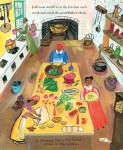
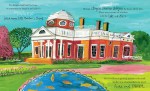
 “Thomas Jefferson: Life, Liberty and the Pursuit of Everything,” by Maira Kalman; Nancy Paulson Press, $17.99, 40 pages, ages 5-8. 

Thomas Jefferson was a study in contradictions.  He believed in freedom for all, yet owned 150 slaves.  He built a gorgeous home at Monticello, enjoyed sumptuous foods, yet at his death, had gone bankrupt from financing his lifestyle.    In Maira Kalman’s latest ode to a great American, she illustrates the complexity and brilliance of our third president in her own inimitable style, intertwining whimsical gouache paintings with flowing, handwritten text. 

I had the pleasure of speaking with Kalman earlier this week.  She discussed her approach to projects and how she writes for children.  This is the first of two articles about her. 

Thomas Jefferson grew out of an online column Kalman wrote in 2009 for The New York Times.  “It’s been part of my life for the past 5 years – going to Monticello and working with the curator there, Susan Stein,” explained Kalman.  “I didn’t know anything about Jefferson, and so I was easily surprised.”  Jefferson possessed an extraordinary desire to learn. Yet, as Kalman concluded, “Coupled with his lifestyle, he was a great study in contradictions.  He was a human being who relentlessly explored everything.” 

 Kalman’s bibliography includes such works as Last Stop, Grand Central; Looking at Lincoln, and Fireboat. In each she is able to explore some difficult topics, yet maintains a certain lightheartedness that makes her work accessible to children.   For example, in Fireboat, Kalman describes the heroic efforts undertaken on 9/11 by the fireboat John J. Harvey.  The boat, built in 1931, was reactivated to pump water when the city’s water mains stopped working and pumped water for 80 hours, until the mains were restored.  

Initially, Kalman didn’t want to write Fireboat, but friend and boat co-owner Florent Morellet pressed her to write it.   “A month after the attacks, he approached me, but I flatly refused – I deal in humor, I told him.  Florent believed that it would be an important book, and that I could do it.  The more I thought about it, the more I realized that I could frame it as a love letter to New York and to the resiliency of the human spirit.”  


In all of her books, Kalman knows exactly how to capture children’s attention.  She is adamant that children can handle any subject – slavery, love, even death – as long as it’s done the right way.  “There’s always a way to talk to children as long as you are candid and kind,“ Kalman said.  ”You don’t have to scare them beyond their understanding or above their age level.  But it’s absolutely possible to talk about anything with children.  Because they do understand contradictions, and they do understand sadness and they do understand kindness. There isn’t a child in the world who doesn’t.”

Next time we talk dogs, deadlines and drawing inspiration. 

Winter 2014 – Fine Books and Collections

Illustrations from Clara and Davie © 2014 by Patricia Polocco. Used with Permission from Scholastic Press.

“Clara and Davie,” by Patricia Polacco; Scholastic Press, $17.99, 40 pages, ages 4 to 6. 

Before she earned her nickname “Angel of the Battlefield" from tending to wounded soldiers during the Civil War, American Red Cross founder Clara Barton (1821-1912) was a shy farmer’s daughter with a lisp, who was home-schooled because classmates teased her.  This tale of inspiration and family strength comes straight from Barton’s own flesh and blood – Polacco is a relative, and as a child was told stories about her remarkable ancestor.

Growing up on a farm in North Oxford, Massachusetts, Barton was the youngest of five children.  Clara was born on Christmas Day, but her mother died shortly thereafter.  Polacco reveals this in such a way as not to frighten young children, yet still manages to poignantly convey the loss; “Mama grew weak from illness. Soon all of the mothering of that baby was left to [Clara’s older sister] Dolly.” Dolly was a stern guardian, but Clara’s great champion was her older brother Davie.  He encouraged her to accept and cultivate her ability to heal others – eventually, farmers would travel from all over for her to cure their sick animals.   Clara’s strength and courage are put to the test when Davie is gravely injured in a fall. 

As mentioned above, Clara was home-schooled – each of her four older siblings was responsible for teaching her a different subject.  She thrived in this homemade schoolhouse, and Polacco’s loving illustrations of the family reading in the parlor surrounded by filled bookshelves is a wonderful testament to the healing power of books. 

Polacco’s trademark storytelling and charismatic illustrations will delight readers of all ages.  Don’t wait until Women’s History Month to read this book – Barton’s rousing story is one to share year-round.

Publication Date: January 28, 2014


AGAIN! Reproduced with permission from the publisher Simon & Schuster. 

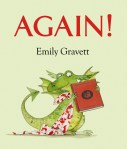
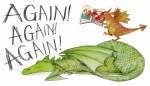
“Again!” by Emily Gravett; Simon & Schuster, $17.99, 32 pages, ages 4-6.

Here we have a great example of why physical children’s books still have an edge over their digital counterparts. In this story, Cedric the dragon prepares for bedtime, which also means mama dragon will read his favorite bedtime story.  As the title aptly suggests, the evening tale is read over and over, even as his very patient and accommodating mother starts to doze off. As a result, Cedric transforms from an almost angelic looking creature into a fire-breathing fiend. Dragons aren’t known for their patience, and Cedric demonstrates his lack of this particular quality with an ending that is sure to enthrall young children. (Without giving it away, this is where the paper copy triumphs over the e-version.) Fans of Emily Gravett’s award-winning illustrations will be happy to see that she has stayed true to her style – simple, engaging drawings that pop off white backgrounds. Readers will recognize Gravett’s work from her other award winning titles such as Wolves and The Odd Egg.

THE RACE FOR THE CHINESE ZODIAC. Text copyright © 2010 by Gabrielle Wang. Illustrations copyright © 2010 by Sally Rippin. Reproduced by permission of the publisher, Candlewick Press, Somerville, MA on behalf of Walker Books Australia and Black Dog Books.

“The Race for the Chinese Zodiac,” by Gabrielle Wang, illustrated by Sally Rippin; Candlewick Press, $14.99, 32 pages, ages 5-7.

In Gabrielle Wang’s retelling of this classic Chinese creation story, the Jade Emperor announces a race to determine which twelve animals will have a year named after them in the zodiac. As the gong sounds, the animals plunge into a mighty river and make their way to the finish line.  Who will be first? Who stops at nothing to win?  Children and adults will find this a pleasure to read, and its quick pace mimics the feel of competitors vying for the top spot. Sally Rippin renders Charming Rat, Spirited Horse and all the other animals in Chinese ink and earth-toned linocuts. 

After reading the end notes to find out which Zodiac year is yours, try this fun post-reading activity: Enlarge the Chinese characters for each animal that are found throughout the book. Give children a big brush and let them trace the characters with bold brushstrokes.  

马年大吉(Wishing you luck in the Year of the Horse!)


Reproduced with permission from Quirk Books 

“Winter Cocktails,” by María Del Mar Sacasa, photographs by Tara StrianoQuirk Books; $22.95, 160 pages, all ages.

No, this is definitely not a book for children, but it would make a wonderful present to parents who have been busy helping Santa prepare for Christmas. These  winter drinks  infuse the body with warmth and ooze holiday spirit.  Recipe developer María Del Mar Sacasa shares 100 delicious liquid infusions such as English Christmas Punch, Salted Caramel Hot Chocolate and Pumpkin-Bourbon Eggnog.  Tara Striano’s enticing up-close photographs plus step-by step photo instructions will bring out the holiday barista in everyone.  Try out the Nutella Melt recipe in the accompanying post and enjoy in front of a blazing fire. 

Photo and Recipe Reprinted with permission from Quirk Books 

This delicious drink, made with Nutella as its base, is a sophisticated take on a childhood staple.  

Nutella Melt
A steamy treat with hints of hazelnut
Serves 4

Nutella, the addictive hazelnut-chocolate spread, melts effortlessly into milk and gets a wink and smile from hazelnut liqueur.

4 cups whole milk

¼ cup Nutella

Pinch salt

6 ounces hazelnut liqueur, such as Frangelico

1 cup heavy cream, chilled

¼ cup confectioners’ sugar

2 teaspoons instant espresso powder

¼ cup toasted hazelnuts, chopped, for garnish

Toasted coconut flakes*, for garnish

*To toast coconut flakes, arrange them in a single layer on a rimmed baking sheet and bake in a preheated 350°F over for 7 to 10 minutes, stirring halfway through baking, until toasted. Alternatively, toast them in a large dry skillet over medium heat, stirring occasionally, until golden, 5 to 7 minutes.

Bring milk, Nutella, and salt to a simmer in a medium saucepan over medium heat, stirring until Nutella is completely dissolved. Stir in liqueur. Turn off the heat but leave the pot on the stove while you whip the cream.

Using an electric mixer, beat cream, confectioners’ sugar, and espresso powder on medium speed in a large, chilled bowl until soft peaks form, 2 to 3 minutes. (Alternatively, beat by hand using a large wire whisk.) Ladle drink into warm cups and top with whipped cream. Sprinkle with hazelnuts and coconut.

Cooking Tip
The most efficient way to remove hazelnuts’ unpleasantly bitter skins is to blanch them. Bring 4 cups water and ¼ cup baking soda to boil in a large pot. Add hazelnuts and boil for 5 minutes. Drain hazelnuts in a colander and rinse them under cold running water, rubbing them against each other until most of the skins have come off. Place hazelnuts in a clean kitchen towel (one you’re not too attached to, because it will stain) and rub them with the towel to remove any remaining skins.

After removing the skins, place hazelnuts on a rimmed baking sheet and bake in a preheated 350°F oven until golden brown and fragrant, about 15 minutes.

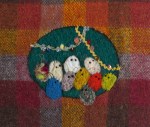
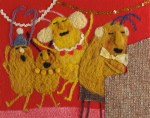
Images reproduced with permission from Phaidon Press.

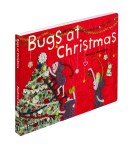
“Bugs at Christmas,” by Beatrice Alemagna, Phaidon Press, $12.95, 38 pages, ages 3-5.

It’s Christmas Eve in the bugs’ cozy blanket world, and they’re trying to organize a holiday party.  Unfortunately, they each seem to have a different idea of how to celebrate; Little Yellow Bug wants to sing Jungle Bugs around a piano, while Little Long-Legged Bug prefers dancing the Santa Samba until he drops. The critters can’t agree on the best way to ring in Christmas until they learn that the spirit of love and togetherness triumphs over creative differences.  Beatrice Alemagna created these surprisingly loveable hairy creatures using appliqué, fabrics, and stitching techniques that together resemble the texture of a nubby, wooly quilt.