For the past two decades, Robert Lawrence Stine (better known as R.L to fans) has written over 300 books full of terrifying tales of goblins and ghosts and shows no signs of slowing down. This year Stine wrote his autobiography called It Came From Ohio: My Life As a Writer (Scholastic Books, $6.99), aimed squarely at his target audience. The author covers everything, from his early years as a clarinet-playing youngster to his experience as a substitute teacher to how he keeps coming up with new stories. Black-and-white snaps of Stine through the years (including the obligatory Bar Mitzvah shot) will no doubt enthrall fans. The book coincides with the recent release of a film adaptation of Stine’s life called ‘Goosebumps’ and stars Jack Black as the author. In an interview this past Sunday with NPR’s Michel Martin, Stine reflected on what he hopes his legacy will be. “I guess on my tombstone – he got boys to read,“ he responded. With 400 million books in print, that sounds like a frightfully sure bet.
(Listen to Michel Martin interview R.L. Stine here)
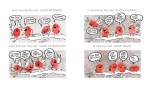
I am Henry Finch, by Alexis Deacon, illustrations by Viviane Schwarz; Candlewick Press, $16.99, 40 pages, ages 3-6.
Henry Finch knows he’s destined for greatness, but until now, all he’s done in life is flutter from tree to tree, outwitting the hungry beast who prowls below. One day Henry has enough of the lubmering creature eating his friends, and realizes this is his chance to be great. Well, Henry ends up in the belly of the beast, but what he does there is a charming ode to courage and resilience. Author Alexis Deacon (llustrator of Russell Hoban’s Soonchild) confirms with wit and humor that heroes can appear from the least likely of places. The birds are rendered as red thumbprints and stick figure illustration (courtesy of There Are Cats In This Book author-illustrator Viviane Schwarz), a reminder that we are all unique and capable of soaring high.
I am a Bear, by Jean-François Dumont; Eerdmans Books for Young Readers, $16.00, 34 pages, ages 4-7.
Hawaii is making news this morning for declaring a state of emergency in order to deal with its surging homeless population, and the story brings up an interesting point: What’s the best way to discuss this with young children? Jean-Francois Dumont’s I am Bear tackles the subject with grace and sensitivity. Winner of the 2004 Prix Saint-Exupery, Dumont explores how societies often dehumanize the homeless by setting a bear right in the middle of a big (Parisian-esque) city. The bear doesn’t know how he arrived on the streets, or what circumstances led him to sleeping under in cardboard boxes, but there he is, like so many of the urban homeless who’ve become faceless and invisible. There’s a lot going on here – compassion, empathy, plenitude in the face of poverty – and yet the author manages to avoid being didactic by keeping the text simple and straightforward. Hope materializes in the welcoming smile of a little girl who looks beyond the dirt and tatters and sees a bear that reminds her of her own beloved playthings. Dumont’s illustrations highlight the duality of urban life and the willing refusal to see the suffering of those right on our doorsteps. This is a book that grows with children as their world becomes larger and they begin to notice people and things around them. While the girl’s compassion is encouraging, it’s not a panacea: The bear remains homeless, but through empathy grows the possibility for change.
As the holidays approach, and with them the usual Christmas/Kwanza/Hanukkah fare, consider this book as an unexpected, poignant, and relevant alternative to teaching kindness.
The Iliad, by Homer, retold by Gillian Cross, illustrated by Neil Packer; Candlewick Press, $19.99 160 pages, ages 9 and up.
Rediscover Homer’s epic poem that pitted the ancient Greeks against the fearsome Trojans in this superb retelling of The Iliad by Carnegie Medalist Gillian Cross, who also refitted the Odyssey for a younger audience. Cross has managed to take this daunting work and wrangle a fluid and enjoyable version full of action and adventure. The book opens with helpful a character map and concludes with the Greek alphabet and an appendix dedicated to discussing whether or not the Iliad was based on a true story. Illustrator Neil Packer, who collaborated on Cross’s Odyssey (2012), returns here to render the scope of human emotions with his instantly recognizable gouache and pen and wash art. (His work ought to be familiar to Folio Society fans: previous commissions for that publishing house include Umberto Eco’s The Name of The Rose (2001) and 2004s illustrated version of Joseph Heller’s Catch-22.) Here, Greeks and Trojans locked in eternal battle are rendered in bold colors and appear as if they’ve been plucked directly from some ancient amphora, and it’s wonderful. (Readers interested in seeing Packer’s art for themselves can do so through October 24 at the Illustration Cupboard in London.) Printed in a large-format volume, this Iliad is a welcome addition to the picture-book world, filling the void between overly sanitized editions and those with blood practically oozing from the binding. A masterful gift for the ages.
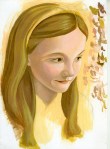
Alice sketch. Reproduced with permission from Grahame Baker-Smith.
Alice sketch. Reproduced with permission from Grahame Baker-Smith.
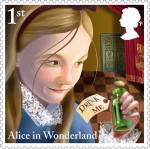
Stamp reproduction from British Royal Mail.
Alice sketch. Reproduced with permission from Grahame Baker-Smith.
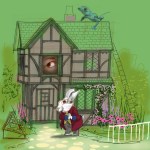
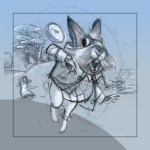
Rabbit sketch. Reproduced with permission from Grahame Baker-Smith.
Lewis Carroll’s classic Alice in Wonderland celebrates 150 consecutive years in print, and it seems every where you look, there’s a book, exhibit, or documentary extolling the various virtues of this timeless tale. Even the British Royal Mail Service got into the spirit by commissioning a special series of stamps. The work was completed by none other than Kate Greenaway Medalist Grahame Baker-Smith. Regular readers of this site might recognize the name: In 2013 Baker-Smith illustrated an edition of The Selfish Giant (Folio Society), and we spoke then about his work. (You can read the conversation here.) Once again, the illustrator generously answered a few more of my questions and sent some stunning sketches he prepared for this most recent assignment. Join me down the rabbit hole with Grahame Baker-Smith as we talk about inspiration, design, and illustrating a legacy.
Who was your design inspiration for Alice and the other characters? (If I may be so bold, there appears to be a family resemblance between you and the Alice character.)
Well spotted Barbara! My ‘muse’ for Alice was my youngest daughter, Lillie. She very patiently and graciously let me take pictures of her doing things like pretending she was falling down a rabbit hole or being squished in the White Rabbit’s house – for which she had to sit scrunched up beneath my table.
Lillie is actually very dark-haired but the Royal Mail wanted a light brown hair color, so in the stamps she looks to me like Lillie but wearing a wig.
How did you choose which scenes to create?
The Royal Mail left the composition to me but had a ‘shopping list’ of scenes they wanted covered. It was a shame there couldn’t have been more than ten designs as characters like the Caterpillar and Tweedle Dum and Tweedle Dee had to be left out.
After 150 years, there’s been plenty of variations in art for the book. What’s it like tackling such a legacy?
Initially slightly terrifying! But, I reminded myself of the fact that the Royal Mail chose me for the thing that I do, so I tried to blot out everything I’d seen and play my natural game. I thought of the set of stamps as pages in a book. It was fabulous when [publishing house] Walker DID actually make them into a book. [The book is published in the United States by Candlewick Press.]
What was your work medium?
Well, everything begins with drawing, lots of drawing, in pencil, crayon, and pen. I tend to paint faces and other parts in acrylic. These are scanned into Photoshop and the rest of the design is built around it using Photoshop vector tools and brushes. I used crisp, clean shapes in Photoshop and minimal texture because of the size of the finished stamp. I needed something that would be very defined and positive at a small scale.
Did you create the pieces on a small scale, or work large and scale down?
Again this was a specific part of the brief. The printing of stamps needs to be very fine to hold the color, tones and textures at stamp-size. So the original images were 170 mm square, four times the size of the finished article. The DPI or print resolution was 600, usually 300 DPI is standard for print.
Did you read Alice in Wonderland growing up? (Or as an adult?) If so, was there a particular illustrated edition that resonated most with you? (Or not at all?)
I didn’t read Alice growing up. It’s one of those stories that, because of endless adaptations, you feel you know even if you’ve never read the book all the way through. I haven’t read it all the way through even now – I really should!
As for illustrations, Tenniel’s are so much a part of the whole legend of Alice it’s difficult to think of it without seeing his version; I also think they are marvelous illustrations anyway.
How do you perceive this story – I’ve spoken to some illustrators who viewed the tale as a whimsical fantasy, and others who saw nothing but a total nightmare, and illustrated it as such.
When I read the chapters pertaining to the scenes I had to illustrate I was enchanted by Carroll’s imagination, it seemed wild and unhinged. The feeling was of someone so in command of his literary prowess that he could conjure virtually anything into being and somehow make it work. I also felt there was an underlying truth that held it together and gave it – despite the utter madness – a gravity. It has something to say about the contrariness of people, the randomness of life and events. Characters like the Cheshire Cat seem to know so much about other people and the way the world really works while the Queen and King, with all the trappings of power, are unconscious beings who, through being unaware cause chaos and feel quite destructive and dangerous individuals.
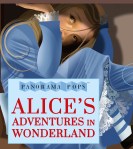
Grahame Baker-Smith’s commemorate stamps are available through the British Royal Mail here, and the book, Alice’s Adventures in Wonderland, published by Candlewick Press, is available for $8.99.
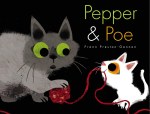
Pepper’s life is the cat’s meow: The green-eyed feline adores lazy Sundays, Mondays, and Tuesdays. Then one Wednesday, a newcomer arrives. Little Poe is smitten with Pepper, but also takes the elder cat’s toys and plays chase all the time. How does Pepper cope with the new addition? Simple high-jinks and a sleepy canine foil complete this tale of feline rivalry. This is the U.S. picture book debut for Sendak Fellowship Recipient Frann Preston-Gannon, and let’s hope there’s more to come from her. Lots of black, neon orange and chartreuse create a visually compelling story, while readers familiar with Charlotte Voake’s excellent 1997 picture book Ginger will notice a similar storyline. Both are sound choices for little cat fanatics learning how to share space and affection.
The Little Witch, by Otfried Preussler, translated by Anthea Bell, illustrated by Winnie Gebhardt-Grayler; The New York Review Children’s Collection, $15.95, 131 pages, ages 6-9.
This spooky story is set on Walpurgis Night, or “Witches’ Night”, which takes place on April 30 in Central Germany. Legend has it that on the highest peak of the Hartz Mountain range, witches gather for an annual nocturnal revelry. All the witches attend, except for Little Witch, who, at 127 years old, is still too young to attend. (At least according to her nasty Aunt Rumpumpel.) Readers will enjoy joining the plucky little sorceress and her faithful Raven, Abraxas, who go forth and prove their worthiness of joining the group by embarking on all sorts of wild adventures. Preussler (1923-3013) continues to be one of the most popular children’s book authors in Germany, and his books have been translated into fifty-five languages. It’s easy to see the enduring appeal: Preussler writes in the tradition of the Grimms, and Bell’s translation is quick-paced and a delight to read. Longtime Preussler collaborator Gebhardt-Grayler’s pen and ink illustrations capture the humor and sensitivity of the text. This classy reissue by New York Review is sure to enchant little readers in search of unlikely heroes. A lovely Halloween treat.
Nice story this morning on NPR about the Kerlan Collection at the
University of Minnesota, a children’s literature repository of over
100,000 books, drafts and manuscripts.










 Literary Features Syndicate