The Whale, by Ethan Murrow and Vita Murrow; Candlewick Press, 32 pages, $17.99.
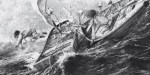
It’s puzzling that the world’s largest mammals are also the most difficult to see, yet the thrill to observe them has gripped the minds of ocean-goers for centuries. In this mostly wordless picture book by debut author-illustrator duo Ethan and Vita Murrow, a pair of intrepid youngsters set out to prove the existence of the Great Spotted Whale, a mysterious beast sighted fifty years ago, but never confirmed. Readers have no choice but to dive right in alongside the plucky voyagers as they gather all sorts of equipment, ready their vessel, and after capsizing their boat, finally lay eyes on the magnificent animal.
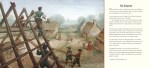
Ethan Murrow’s graphite black-and white illustrations are meticulously rendered, evoking the gray, salty sea-spray-covered ocean landscape and all the flotsam therein. The Whale celebrates a quixotic accomplishment with an amazing tale that radiates youthful energy, and should be part of any explorer’s library. Here’s hoping the Murrows set their sights on another project soon, and invite us along their next great adventure.
Platypus, by Sue Whiting, illustrated by Mark Jackson; Candlewick Press, 32 pages, $16.99, ages 6-9.
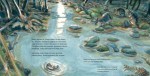
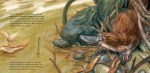
Have you ever taken a good look at a platypus? Outfitted with a duck’s bill and webbed feet, this mammal has a flat tail like a beaver, but lays eggs and provides milk to its young. Australian picture-book authorSue Whiting examines the peculiarities of this marvelously puzzling creature by weaving lyric prose with scientific text. Expertly matched by fellow Aussie Mark Jackson’s mixed-media illustrations, Platypusunravels the mysteries of one of natures most secretive and peculiar creatures for early readers.
A Big Surprise for Little Card, by Charise Mericle Harper, illustrated by Anna Raff; Candlewick Press, 40 pages, $16.99, ages 4-7.
In a tidy residential tower of cards, every paper-based inhabitant has a job–Round Card is a price tag, Wide Card is a postcard, and Tiny Card is a prize redemption ticket. Only Long Card and Little Card haven’t learned their destinies. One day Little Card receives a letter informing “L.C.” that he is to become a birthday card, and he rushes off to birthday-card school. Unfortunately, the letter was meant for the other L.C., Long Card, and though the mix-up is soon cleared, there’s no time for re-education. Little Card is immediately sent to a girl named Alex to be her brand-new library card. Together the pair discover the joys of the library, and though shouting is frowned upon, they find plenty of wonderful reasons to celebrate libraries, making everyday a Happy Library Day. Just Grace series author Charise Harper’s ode to her own Vancouver Public Library is expertly matched by Anna Raff’s (World Rat Day) exuberant mixed-media collages. Librarians everywhere will certainly bookmark this as a sweet, slightly nutty addition for story-times dedicated to explaining the function and importance of libraries.
From the State House and the Public Garden to Fenway Park, fourteen of Boston’s iconic sites are represented in the latest edition to Candlewick’s Panorama Pops collection. British illustrator Charlotte Trounce captures the city’s famous sites with charm and grace.
A clever, pocket-size memento of the Hub that’s portable and affordable.
BOSTON: Panorama Pops, illustrated by Charlotte Trounce; Candlewick Press, $8.99, 30 pages, ages 5 and up.
“The Race for the Chinese Zodiac,” by Gabrielle Wang, illustrated by Sally Rippin; Candlewick Press, $14.99, 32 pages, ages 5-7.
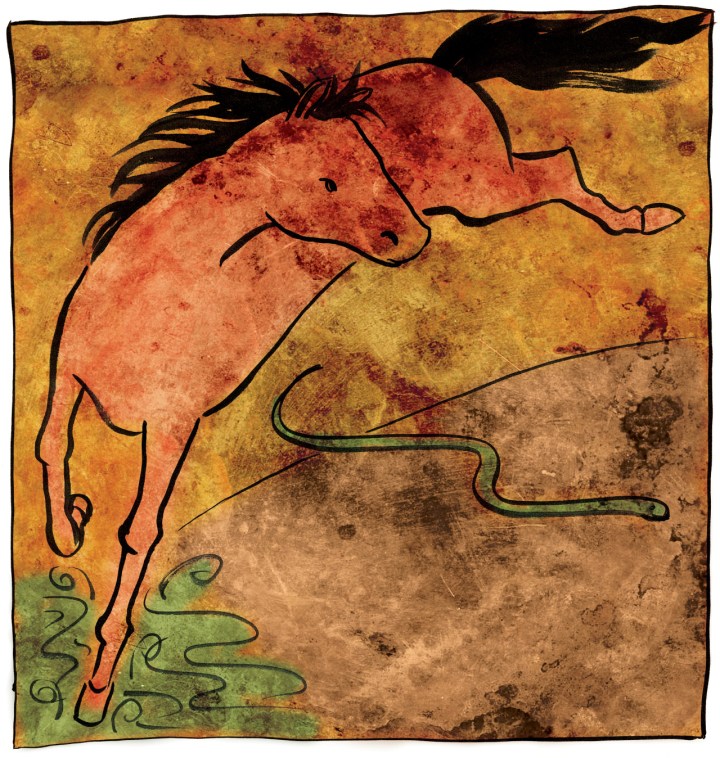
In Gabrielle Wang’s retelling of this classic Chinese creation story, the Jade Emperor announces a race to determine which twelve animals will have a year named after them in the zodiac. As the gong sounds, the animals plunge into a mighty river and make their way to the finish line.Who will be first? Who stops at nothing to win?Children and adults will find this a pleasure to read, and its quick pace mimics the feel of competitors vying for the top spot. Sally Rippin renders Charming Rat, Spirited Horse and all the other animals in Chinese ink and earth-toned linocuts.
After reading the end notes to find out which Zodiac year is yours, try this fun post-reading activity: Enlarge the Chinese characters for each animal that are found throughout the book. Give children a big brush and let them trace the characters with bold brushstrokes.
马年大吉(Wishing you luck in the Year of the Horse!)
Here’s a reblog of one of my favorite books about Chinese New Year. 恭禧发财! (Gong Xi Fa Cai)
How the Sun Got to Coco’s House, by Bob Graham; Candlewick Press, $17.99, 40 pages, ages 3-6.
Every day the sun rises across the globe, and in his latest picture book, Bob Graham tracks it across frozen forests, vast desserts, remote mountainside villages and bustling city streets until it bursts through little Coco’s bedroom window. Graham’s watercolors create a world awash in welcoming rays of sunlight (though every corner of Graham’s world appears to be covered in snow), and with perfect cadence illustrates how each sunrise is a shared gift that every creature on earth enjoys. A lovely read-aloud for young children that gently introduces the idea of a global community.
For a pleasant mid-winter mix, we offer two books in the spirit of warmth and love.
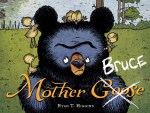
Mother Bruce, by Ryan T. Higgins; Hyperion Books, $17.99, 48 pages, ages 4-8.
Bruce
is a solitary type of bear–downright grumpy, in fact. His single joy is cooking eggs. Bruce scours the forest for his hard-shelled treats, harvesting them for
complicated recipes he finds on the internet. (Naturally, there’s WIFI
in his den.) One day, a clutch of locally-sourced goose eggs hatches,
and Bruce has to put aside his own concerns in order
to raise the baby chicks. Alongside plenty of edgy adult humor to
keep parent and child entertained, Higgins offers a droll examination of interspecies
families and unconditional love.
Fans of Lemony Snicket’s The Composer is Dead and cover art for the band The Decemberists will quickly recognize the work of Carson Ellis in her debut solo picture book. Here, Ellis employs gouache and ink to showcase all the different fanciful places that may be called home. Whether it’s a Norse god at Valhalla, a Keynan blacksmith at his abode, or an old lady and her shoe, each homebody is united by the fact that their dwellings all provide warmth and protection. (Keep an eye out for Ellis herself, hard at work in her studio.) Whimsical and touching, this is a tender reminder that no matter what you call it, home is where the heart is.
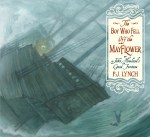
The Boy Who Fell Off the Mayflower, or John Howland’s Good Fortune, by P.J. Lynch; Candlewick Press, $17.99, 64 pages, ages 7-10.
Here’s a Thanksgiving story that fully examines the adventure, faith, luck, and unity that defined the Pilgrims’ early days in America. Award-winning author and illustrator P.J. Lynch’s latest children’s book focuses on the life of John Howland (c.1591-1672), an indentured servant who sailed aboard the Mayflower and eventually became the executive assistant to John Carver, New Plymouth County’s first governor. Told in the first person, the fictionalized account of Howland’s crossing takes on a dramatic sense of urgency–England’s Separatist church members (they weren’t pilgrims yet) were being jailed and harassed, and though they had found religious asylum in Holland, church members feared a war with Spain would again put their community in peril.
Lynch details a journey that seems doomed from the get-go (the Mayflower’s sister ship, the Speedwell, never even crossed the Atlantic), and at times it looks like the group won’t make it. (Re-read the title. Howland actually fell off the Mayflower during a storm. That historical nugget inspired Lynch to write the book.) Though originally headed for Virginia, fierce storms bobbled the ship two hundred miles off course, to Cape Cod, where the weary travelers set ashore, where another adventure of survival awaited. Lynch’s gouache paintings expertly capture both the squalor of London and the wilderness of New England. (This is the first book Lynch has both written and illustrated.) Samoset, Squanto, and the great Wampanoag sachem Massasoit are also richly rendered, highlighting the peace these groups enjoyed throughout Howland’s long life. The feast scene is particularly warm, especially after reading about the unforgiving first winter. (Nearly half the settlers died, and lodgings were little more than canvas stretched wooden frames.) The Boy Who Fell Off the Mayflower also provides surprisingly relevant food for thought in our current debates over refugees seeking religious asylum. The author’s notes and bibliography offer further resources for learning more about this pivotal moment in history.
Today I’m excited to share my Q&A with Maggie Thrash, whose emotional graphic novel, Honor Girl (Candlewick Press, $19.99, 272 pages), chronicles a fateful summer when the author first fell in love while at an all-girls sleepaway camp in the South. Thrash, also a writer for Rookie Magazine, spoke with me about accepting and embracing her sexuality, her years at Hampshire College, sleepwalking, the mental demands of riflery, and recognizing that pivotal moment when you realize you’ve grown up.
What moved you to write Honor Girl at this point in your life?
I needed to say this before I could say anything else. This book is the Maggie Thrash starting point. So much about my life– the way I think, the way I deal with love– all traces back to how I handled this summer. It was the first time in my life that I was faced with real, intense, adult emotions. Before this summer, I was a kid, and afterwards I was not—and there was no going back.
Why did you decide to write a graphic novel instead of a traditional book? Honor Girl focuses on a very specific period in your life – your discovery/acknowledgement of your sexuality, and your first love. Was it difficult reliving your adolescence? Was this book your way of coming out to the world?
I think comics are the best medium for memoir because you can be up-front and objective about yourself while also being incredibly personal. It wasn’t very difficult for me to relieve this period, because in many ways I’m kind of stunted– I still feel fifteen years old. So it wasn’t a stretch for me to reach back and relive those feelings. And yes, this is definitely me coming out to the world. I’d always been very secretive about my relationships with women, because being secretive made life easier. But the world has changed a lot in the last fifteen years, and diversity is being celebrated now.
Did you ever reconnect with Erin, or is she firmly in the past?
She’s read the book, and we’re going to have lunch soon…. I’m kind of terrified! It must be very strange to see yourself and your memories through some else’s eyes, and to have that version published for the world to see. But she has been immensely supportive and cool.
What happened afterwards? You attended Hampshire College, and as a fellow graduate of a Pioneer Valley school (Smith), I can easily imagine that Hampshire was a far cry from Bellflower and Atlanta. Did you experience any culture shock when you got to college? What were your first impressions? How did attending Hampshire, and spending your undergraduate years in such an environment, influence your work and life?
Yes, Hampshire College was a huge shock! There was a nudist, and a girl who made art exhibits out of garbage piles, and a guy who dressed like a pirate every single day. The place was teeming with gay people and nonconformists and a wide variety of weirdos. It’s funny, on the first day of orientation, I found this one Midwestern boy who was wearing “normal” clothes– like a Polo shirt and jeans– and I latched onto him and he became my best friend. We navigated all the craziness together. I have probably never been happier in my life as I was at Hampshire College. It is a strange, wonderful heaven.
Have you stayed in touch with any of the girls from Bellflower?
I purposefully avoided contacting anyone while I was writing the book. I wanted to stay true to my perspective and not feel beholden to other people’s memories. It’s wild how two people can remember one event so differently. The idea of having to serve multiple perspectives was too overwhelming. All the girls in the book have their own stories. What ended up happening to the character of “Bethany” is pretty crazy, for instance. It could be a whole book of its own. But I was just like, I gotta stay focused and tell my own story here.
As a writer for Rookie you know that many young girls read and look up to you. Did you feel any of that pressure while writing?
Rookie readers are very compassionate. They get that everyone is flawed. I am not a fantastic role model in Honor Girl. I let people push me around, and I didn’t have confidence in my feelings or my intuition. But it’s important for me to be real with girls and to tell them, “You’re gonna lose some battles in life. It happens. It doesn’t mean you’ll be a loser forever.”
You’re pretty good with a gun, but you haven’t shot anything in over a decade. Why? Do you miss it? Could you talk about why you took up riflery in the first place? (You allude to riflery as a way to bond with your father.)
It’s pretty random how I took up shooting. Mostly I did it because it wasn’t a popular activity at the camp, so it was a great way to get away from everyone (at camp you’re constantly surrounded). I definitely didn’t expect to be such a prodigy. Riflery is an interesting sport, because all it takes to excel is concentration and confidence. It’s 100% mental. When I went back to camp the next summer, the summer after the one portrayed in the book, I was a different person. My confidence had faltered, and I lost my magic. Like most prodigies, I totally flamed out. I want to shoot soon just to see what happens, to see if lost magic can be recovered. I’ll let you know how it goes!
Do you still sleepwalk? If so, what do you do about it? If not, how did you stop?
I rarely sleep-walk anymore. I grew out of it I guess. But I have a new, equally disruptive sleep malfunction where I wake up in the middle of the night screaming my head off. Usually I’m screaming for my dad, like, “DAAAAAAAAAAD!” It’s probably a deeply ingrained thing for girls in this patriarchal society, to scream for their fathers to save them.
Did you really see Brigadoon after you left camp? It seemed an appropriate coda to Bellflower disappearing into the past, just like Brigadoon vanishes into the ether.
Oh yeah. Every year my mom and I saw a musical on the way home from camp.Brigadoon always stuck with me. Partly because I’m Scottish and because the title song is so beautiful. But I also love how Brigadoon represents how nothing lasts. All anyone wants is to be happy and for time to stop. Brigadoon captures those two impossible desires.
What are you working on now?
I have something pretty different in store for next year. It is fiction, and non-graphic. It’s a teen mystery. I think it will be interesting for Honor Girl readers to read it and be like, wow, so this is what became of Maggie Thrash. She grew up to write books about teenagers murdering each other. Nice.
Honor Girl, by Maggie Thrash; Candlewick Press, $19.99, 272 pages, ages 14 and up.
I am Henry Finch, by Alexis Deacon, illustrations by Viviane Schwarz; Candlewick Press, $16.99, 40 pages, ages 3-6.
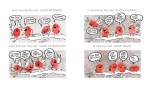
Henry Finch knows he’s destined for greatness, but until now, all he’s done in life is flutter from tree to tree, outwitting the hungry beast who prowls below. One day Henry has enough of the lubmering creature eating his friends, and realizes this is his chance to be great. Well, Henry ends up in the belly of the beast, but what he does there is a charming ode to courage and resilience. Author Alexis Deacon (llustrator of Russell Hoban’s Soonchild) confirms with wit and humor that heroes can appear from the least likely of places. The birds are rendered as red thumbprints and stick figure illustration (courtesy of There Are Cats In This Book author-illustrator Viviane Schwarz), a reminder that we are all unique and capable of soaring high.










 Literary Features Syndicate