

“Five-Plant Gardens,” by Nancy Ondra, photographs by Rob Cardillo; Storey Publishing, $18.95, 184 pages.

image

image

image

Excerpted from Five-Plant Gardens © Nancy J. Ondra. Photography by © Rob Cardillo. Illustrations by Beverly Duncan. Used with permission of Storey Publishing.

In this, the inaugural post for Literary Features Syndicate’s new webpage, we welcome the return of spring by sharing a book that heralds the arrival of warmer weather, and entices readers to work their backyards into striking rainbow oases.

Veteran horticultural writer Nancy Ondra takes the guesswork out of designing perennial gardens in this guidebook geared to the novice or perpetually brown-thumbed gardener.  In addition to defining useful terms, such as annual vs. perennial plants, Ondra, proposes that anyone will find success planting these gardens using five main plants.  She even maps out how and where to stake out a plot.  Perhaps most encouraging of all, all of the plants in the book are relatively inexpensive and are found at most major garden stores. Ondra estimates that a gardener can plant an entire garden over the course of a weekend at a cost of about $200.

The gardens in this book are divided by light exposure and soil moisture content, leaving little room for error when choosing sun or heat-tolerant species.  Ondra’s bright, color-coordinated planting plans complement beautifully Rob Cardillo’s bright photographs of various ferns, herbs and flowers.

This tome offers a jolt of encouragement that an eye-catching, well-planned and budget-friendly garden is within the reach of any gardener. 
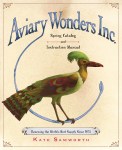
AVIARY WONDERS INC. ©2014 Kate Samworth. Reproduced with permission from HMH Books for Young Readers.

“Aviary Wonders Inc. Spring Catalog and Instruction Manual: Renewing the World’s Bird Supply since 2031,” by Kate Samworth, Clarion Books, $17.99, 32 pages, ages 9-12.

Hunting, habitat loss and climate change are driving bird species to extinction at a record clip. But what if carrier pigeons could once more take flight, simply by assembling various interchangeable parts?  Debut author-illustrator Kate Samworth explores this imaginative possibility in a book that is by turns funny and unsettling.  Samworth says the inspiration to sketch a bird catalog came after listening to New Orleans residents talk about the eerie lack of birdsounds post-Katrina.  

Modeled after an old-fashioned mail-order catalog, this fantasy avian sales prospectus is the brainchild of logging company magnate Alfred Wallis, who established Aviary Wonders Inc. after noticing that birds vanished shortly after loggers chopped down their homes. The catalog offers an assortment of feathers, bodies, beaks and legs for bird lovers to create a  feathered friend to call their very own.  The second half of the catalog is amusingly devoted to assembly, troubleshooting tips, and even includes an order form. 

The ‘catalog’ is peppered with cheeky advertising banter alongside some very real facts about endangered and extinct species. Samworth’s stunning oil paintings are as bright and cheerful as the underlying message of habitat destruction is serious. 

Aviary Wonders Inc. flies solo as one of the most unique books for bird-lovers of all ages, and despite its zany premise, will spur lively environmental and scientific discussions.

Image reproduced with permission from Sterling Publishers.  ©2014 Linda Beck.

“Goodnight Songs,” by Margaret Wise Brown, illustrated by various illustrators, Sterling Children’s books, $17.95, 28 pages, ages 2-5.

For over sixty years, children have drifted to dreamland after reading the quintessential bedtime story Goodnight Moon. Now comes a previously unpublished collection of Margaret Wise Brown’s charming lullabies for a new generation of readers.

Amy Gary, the editor of Brown’s Estate, introduces the collection by describing her discovery of a treasure trove of manuscripts. Tucked away for decades in a trunk in an attic barn on the author’s family farm in Vermont, all but three have never been printed until now.

Also among the hidden treasures were musical scores Brown was composing for a children’s record company. An accompanying disk includes songs based on the poems. Emily Gary and Tom Proutt set the poems to music, and managed to capture the effortless imagery of Brown’s work. 

A different contributor illustrated each poem and the list reads like a who’s-who of award winning artists. Caldecott Honor medalist Melissa Sweet, Coretta Scott King Honor Award winner Sean Qualls, and New York Times Best Illustrated Book winner Carin Berger were among the dozen asked to collaborate on the project.  Brown’s innate understanding of what entertains and comforts children will delight everyone who comes across this gem, now and for years to come.    

 “Penguin in Peril,” by Helen Hancocks; Templar Publishing, $17.99, 32 pages, ages 3-6.


When three cats spend their last few dollars on movie tickets instead of dinner, disaster seems imminent for the famished felines. Undaunted, they decide that the best way to ward off hunger is to kidnap a penguin from the local zoo and force him catch fish for them.  Their plan fails, the penguin escapes, and a lively chase ensues.  Helen Hancock’s debut picture book will delight young readers, but adults may find that the narrative feels flat in spots.  Regardless, the amusing gouache illustrations are fantastic – they’re bright and entertaining, coupled with just the perfect touch of mischief. Children will enjoy searching for the wayward waddler as he blends in with a group of nuns, waiters, and other madcap city scenes. 

 Under the Sea

“Octopus’s Garden,” by Ringo Starr, illustrations by Ben Cort; Aladdin Books, $17.99, 32 pages, ages 1-6.

Beatles fans have had much to celebrate recently – February marked the fiftieth anniversary of the group’s stateside arrival at Idlewild (JFK) Airport, heralding a massive sea change in pop music.  A large piece of Ed Sullivan’s stage where the Fab Four signed their names is heading to a New York City auction, where experts estimate it could fetch anywhere between $800,000 and one million dollars.

And Ringo Starr is as busy as ever – in addition to planning a tour this summer and recording new music, he recently authored a children’s book.   The drummer’s 1969 hit “Octopus’s Garden” is perfect for young audiences, and it’s surprising that in the song’s forty-six years of existence, this is the first time it has been adapted into book form.

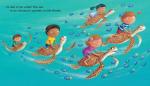
The original lyrics swim along to Ben Cort’s playful and cheery illustrations.  A smiling, bright orange cephalopod welcomes a group of adventurous children into his fanciful submarinal plot filled with dancing starfish, sticky sea cucumbers and other playful ocean creatures.  Children will adore the story, and parents of all ages will find themselves unconsciously humming the happy tune.

Perhaps the highlight of this publication is the accompanying audio disk, which features Ringo on four separate tracks. He introduces himself to a new generation of readers, sings a fresh recording of the song (which sounds a lot like the original,) reads the book aloud, and even offers an instrumental version of “Octopus’s Garden” for children to sing along, karaoke-style.  What a wonderful way to spend a day. 

Octopus’s Garden

 “Brimsby’s Hats,” by Andrew Prahin; Simon & Schuster, $15.99 40 pages, ages 4-8.

Another Nor’easter is snarling travel and closing schools along much of the East Coast this week, so how better to take the snow in stride than by looking at a lovely new picture book that examines love, loss and  friendship, no matter what the weather brings. 

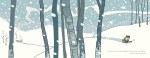
In this snowy story, we meet a hatter whose daily routine consists of drinking tea and creating fabulous toppers alongside his best friend, and this is how he happily leads his life for many years.  One day, his pal announces that he is leaving town to realize his dream of sailing the high seas.  The hatter continues making hats and drinking tea, but it’s not the same.

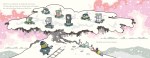
After many days of quiet and solitude, the lonely hat maker sets out to find new friends, and comes upon a large tree filled with birds busily shoveling snow out of their nests.  What follows is a quirky examination of how friendships are built and maintained. 

Debut author-illustrator Andrew Prahin weaves a timeless tale with modern imagery – all the art was created in Adobe Photoshop. 

Enjoy this book with little loved ones, snuggled up by the fire or under a wintry windowpane, and dream of spring. 

 “Titanic: A picture history of the shipwreck that shocked the world,” by Sean Callery; Scholastic Press, $15.99, 112 pages, ages 11-14.

If the most recent round of snowstorms have left you feeling high and dry, consider the poor souls who suffered on the ill-fated Titanic. The latest the latest installment in Scholastic’s Discover More series  explains the story of the glorious “ship of dreams” through a treasure-trove of pictures from the era.

The tragedy unfolds in pictures, starting with the details that made the Titanic such an exciting, luxurious ocean liner, to letters and pictures of survivors from the wreck. What really sets this and all of the books in the Discover More series ahead of the pack is the interactive component.  A digital companion book is accessible free with the book’s purchase (the access code is located inside the physical book) and features five survivors’ stories.  No new historical ground is uncovered here – Scholastic’s simply put together a great book for young history buffs interesting in learning about one of the world’s most famous disasters at sea. 

2014 Newbery and Caldecott Winners

The American Library Association announced the winners of the 2014 Newbery and Caldecott medals on Monday.   A panel of fifteen librarians from across the country gathered to honor the very best children’s books.  What distinguishes the two awards? The Newbery Medal goes to the author of “the most distinguished contribution to American literature for children.”   The Caldecott recognizes an artist’s excellence in picture book illustration.  Here they are:

 “Flora and Ulysses: The Illustrated Series,by Kate DeCamillo, illustrated by K.G. Campbell; Candlewick Press, $17.99, 240 pages, ages 9-12.

In this adorable ode to superheroes, comic-book aficionado Flora sets on a series of adventures with a witty squirrel appropriately named Ulysses. DeCamillo’s humor (and wonderfully rich vocabulary) is perfectly matched by comic book artist’s K.G. Campbell’s black and white illustrations.  Readers will adore that this quirky action-packed novel matches a sensitive, sophisticated story.


Honor Books:

“Doll Bones,” by Holly Black; Margaret K. McElderry Books, $16.99, 256 pages, ages 10-14.

“The Year of Billy Miller,” by Kevin Henkes; Greenwillow Books, $16.99, 240 pages, ages 8-13.

“One Came Home,by Amy Timberlake; Alfred A. Knopf, $16.99, 272 pages, ages 9-13.

“Paperboy,by Vince Vawter; Delacorte Press, $16.99, 240 pages, ages 10-14.

Caldecott Medal Winner:

“Locomotive,” by Brian Floca; Atheneum Books for Young Readers, $17.99, 64 pages, ages 4-10. 

This year’s Caldecott winner is a picture book rich with sensory details about America’s first trans-continental railroad.  The rolling text mimics the turning of the wheels and the rumbling of the train down the track.  Sumptuous images will easily captivate young readers, despite the book’s length. 


Honor Books:

Journey,” by Aaron Becker; Candlewick Press, $15.99, 40 pages, ages 4-8.

“Flora and the Flamingo,” by Molly Idle; Chronicle Books, $16.99. 44 pages, ages 4-8.

“Mr. Wuffles!”  by David Wiesner; Clarion Books, $17.99, 32 pages, all ages.

MANHATTAN – The Little Prince is most often associated with the City of Lights.  Yet Antoine de Saint-Exupéry’s wartime tale took shape in a rented house on Beekman Place in the heart of New York.  In fact, the ex-pat French aviator – who spoke almost no English – spent two years in Gotham, writing and reworking what would ultimately become one of the best-selling and most-beloved books in history.  As much as the world considers The Little Prince to be a French masterpiece, it took shape and drew inspiration from the people, sights and sounds of Manhattan.

The Morgan Library celebrates the book’s 70th anniversary with an impressive exhibition of the author’s working manuscripts and drawings, as well as other memorabilia such as personal communications, photos, journals and books.  The show opens to the public January 24th and runs through April 27th.    

So how much did the City that Never Sleeps inspire Saint-Exupéry?  Portions of the working manuscript on display show the author referencing iconic landmarks such as Rockefeller Center.  Some of the drawings also appear to be inspired by skyline views of Manhattan.  Much was ultimately removed from the final product, but these coffee and cigarette stained documents provide a fascinating look into the creative process.  Saint-Exupéry was also notorious for working through the night, often surrounded by reams of onion-skin paper – which, when examined under proper lighting, reveals the watermark Fidelity Onion Skin. Made in U.S.A.  

Admirer and fellow aviator Ann Morrow Lindbergh’s diary is also on display and open to a passage where she reflects on what she considered the  “eternal sadness – eternal hunger – eternal searching”  of the work.  Orson Welles loved the book so much that he bought the screen rights; his annoted screenplay is here as well. Perhaps the most moving object is an identification bracelet worn by Saint-Exupéry when his plane was lost at sea.  It was recovered by a Marseille fisherman in 1998.   To the end, the author embraced New York – alongside his name is engraved the Park Avenue address of his publisher.