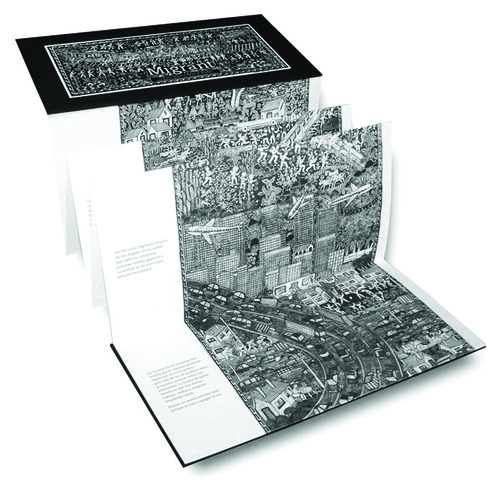
Migrant, by José Mateo, illustrated by Javier Martínez Pedro. illustrations © Javier Martínez Pedro.
I spoke with author José Mateo about his inspiration for Migrant, the significance of the codex format, and what he hopes to achieve with this book’s publication.
In the spirit of Migrant, I have included the Spanish as well as the English translation of our conversation.
All translations are my own.
¿Hubo una inspiración personal para esta historia? ¿Podría hablarnos de esa experiencia?
Was there a personal inspiration for this story?
En realidad no. Para escribir este relato me basé en diversos testimonios de niñas y niños migrantes tomados de la prensa, libros y documentales. También de historias personales que he escuchado desde hace por lo menos treinta años.
Not really, no. To write this story, I relied on testimony from migrant children taken from newspapers, books and documentaries as well as personal stories I’ve heard over the past thirty years.
¿Podría hablar un poco acerca de por qué usted utilizó el formato del Codex para el libro?
Could you talk a little about why you chose to write the book in codex form?
La idea es de Cristina Urrutia, editora con una amplísima experiencia y profundo conocimiento de la historia de México. Una vez que ella comentó la posibilidad de que el libro se armara a la manera de un códice prehispánico, mi tarea fue, más bien, pensar y organizar el relato en fragmentos narrativos que se ajustaran al número de dobleces que tendría el libro. Fue un proceso de mucho diálogo e intercambio de opiniones.
The idea is from Cristina Urrutia, an editor with extensive knowledge of Mexico’s history. She felt we should arm the book as a pre-Hispanic codex, and my task was to organize the story in narrative fragments adjusted to the number of folds in the book. It was a long process and we were in constant dialogue.
¿Sabía usted concibe este trabajo juntos? Las palabras y las imágenes son sin fisuras.
Did you and Mr. Pedro work together? The words and images are seamless.
Primero escribí la historia y fue con base en ella que Javier comenzó a ilustrar. Él y yo sólo conversamos una vez, cuando sólo le faltaba ilustrar la parte final del relato; intercambiamos entonces algunos puntos de vista sobre el aspecto de las ciudades estadounidenses.
En ese sentido, la ilustración de Migrar es única, no recuerdo ninguna otra imagen en papel amate donde se represente un viaje de migración con tanto detalle ni donde se incluyan espacios urbanos de Estados Unidos.
I wrote the story first, and Javier worked with the text to create the illustrations. We only spoke once, when he was illustrating the final part of the story. We also discussed various aspects of American cities.
The illustrations for Migrant are unique. I cannot recall any other images on amate paper where both the illegal immigration journey and U.S. urban spaces are rendered in such detail.
La lucha de la inmigración continúa. ¿Qué espera lograr con la publicación de este libro? ¿Has visto notable cambio (positivo o negativo)?
The immigration struggle continues. What do you hope to achieve with the publication of this book? Have you seen any (positive or negative) change?
Nuestra intención era colocar en primer plano la experiencia de las niñas y los niños que se ven obligados a dejar su casa y, en la medida de lo posible, señalar que nuestro país no cumple con los derechos que deberían estar garantizados para toda la población infantil. Queríamos que el libro incorporara la realidad compleja que experimentan las familias; que se notara cómo las madres, los padres, las hijas y los hijos luchan por mantenerse unidos y cómo uno de los propósitos de la migración tiene que ver con la lucha por conseguir un trabajo. Sin un trabajo digno y bien remunerado, las familias quedan en riesgo padecer hambre, enfermedades e incluso de ser víctimas de los criminales o de autoridades sin escrúpulos.
Our intention was to highlight the experience of children who are forced to leave home and note that our country does not comply with certain rights that should be guaranteed for all children. We wanted the book to incorporate the complex reality experienced by families: The struggle of mothers, fathers, daughters and sons to stay together: How one of the purposes of migration revolves around the struggle to get a job. Without decent and well-paid work, families are at risk of hunger and disease. They even become victims of criminals or unscrupulous authorities.
¿Hay algo más que le gustaría compartir con nuestros lectores sobre este libro impresionante?
Is there anything else you would like to share with our readers about this stunning book?
Sólo me gustaría añadir que el relato recupera en parte otra experiencia de lectura: la del escritor José Revueltas, para mí el mejor de los narradores y ensayistas que dio México en el siglo XX. Gazul, el nombre del perro que aparece en la historia, viene de una de las novelas de Revueltas.
José Revueltas is, for me, one of the best storytellers to come out of Mexico in the twentieth century. Gazul, the dog that appears Migrant, comes from one of Revuelta’s novels.




 Literary Features Syndicate