IN MEMORIAM

Midnight: A True Story of Loyalty in World War I, by Mark Greenwood, illustrated by Frané Lessac; Candlewick Press, $16.99, 32 pages, ages 8 and up.

On Halloween Night in 1905, a horse was born on a cattle ranch in New South Wales, Australia. Twelve years later to the day, that horse, appropriately named Midnight, would participate in the Charge at Beersheba, one of the last great cavalry charges in military history, which resulted in the victory that led to the eventual collapse of the Ottoman Empire. Here, award-winning author Mark Greenwood (The Legend of Moondyne Joe; The Greatest Liar on Earth) goes back to his Australian roots by sharing the story of this remarkable mare and her brave owner, Guy Haydon. Greenwood deftly traces the course of Midnight’s life as it changes course from cow horse to member of the Australian Light Horse Brigade, and does such a masterful job of it. This is a story of bravery and sacrifice, and it will bring tears to all who read it. (This is not suitable for bedtime; in addition to its somber tone, the tale will incite  discussion and an immediate desire to learn more.) Illustrator Frané Lessac traveled to Be’er Sheva in Israel with Greenwood in order to see firsthand where Guy and Midnight participated in the charge. The trip bore fruit: pigment-saturated gouache illustrations capture the desert sands and blood-red skies of battle. Complete with detailed endnotes and photographs of the real Guy and Midnight, this is a perfect example of history leaping off the pages and into readers’ lives. (Walker Books, Midnight’s Austrailian publisher, put together a wonderful teacher’s guide, which would also be useful for Americans who may be less familiar with this particular part of WWI history.)
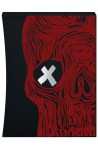
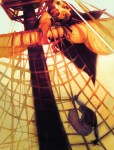
IN THE NEWS: Congratulations to Sterling Hundley, the overall winner of the V&A Illustration Awards. Hundely took home the award for best book
illustration for his artwork in the Folio Society’s edition of Treasure Island. Judges described his work as “richly coloured, atmospheric and stylistically consistent’,‘appropriately sinister’ and‘bold, brave and powerful”. (Read the entire press release here.) The awards ceremony took place on May 18 at the Victoria & Albert Museum.

Learn more about this American artist and his method – my profile on Hundely,  appeared on the Fine Books & Collections Blog in January.

http://bit.ly/1IkvmGL

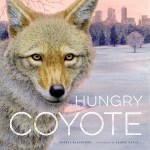
Hungry Coyote, by Cheryl Blackford, illustrations by Laurie Caple; Minnesota Historical Society Press, $16.95, 32 pages, ages 3-7.

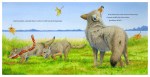
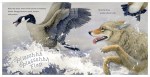
Coyotes are flourishing throughout North America, and have thoroughly adapted to urban environments – New York seems to be a perfect habitat for these nocturnal creatures, but the animals are quite at home in most cities across the country.  In Hungry Coyote, Cheryl Blackford details a year in life of a coyote constantly on the prowl for his next meal. He rummages for leftovers from a summer picnic,  forages vegetables from a garden, and even procures an old goose to feed his growing family. The writing is crisp and snappy, with just enough detail for young readers. Endnotes explain just how much real estate humans share with coyotes (it’s a lot), as well as why it’s pretty unlikely for a coyote to attack a human. (A Yorkshire Terrier relieving himself in the backyard at midnight, however, is another story.) Laurie Caple’s paintings are expertly rendered with watercolor and pastels, and are a visual treat for nature enthusiasts. Hungry Coyote is a beautiful ode to an often reviled animal, and encourages readers to appreciate (and perhaps enjoy) the fact that such a beast lives among us.  

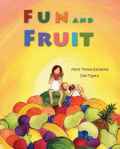
Fun and Fruit, by María Teresa Barahona, translated by Jon Brokenbrow, illustrated by Edie Pijpers; Cuento de Luz, $16.95, 24 pages, ages 5-7.

Charlotte and Claire live in a magical world among thousands of delicious fruit-bearing trees. To pass the time, the girls choose a special color each day, and tell each other stories about their snack before eating the fruits in that hue. And so begins Fun and Fruit, a mouth-watering tale exhorting the benefits of healthy eating.   María Teresa Barahona’s text retains its upbeat, bouncy feel in translation (the book was originally published in Spanish as ¡Qué divertido es comer frutas!), but, as happens sometimes with books that veer to the pedantic, some of the tales are more earnest in their message than others. For example, after the girls imagine lemons as clouds, they ask their cousins to fashion an apple-shaped ball to keep soldiers busy at soccer instead of fighting. Other, better, fruity stories inspire the girls to heal the sick and be good friends. Despite a few missteps, Fun and Fruit isn’t overly heavy, and may very well find its place as a tool to help children understand their feelings. Since most Cuento de Luz’s publications are originally in Spanish, some of their titles (like Fun and Fruit) seem like natural fits for language instruction – a peppering of words for colors and fruits would have been perfectly at home in this book.

The art is a feast for the eyes. Dutch artist Edie Pijpers’ paintings are saturated with mouth-watering melons, figs, and coconuts, while her renditions of smiling, caring children are reminiscent of Helen Oxenbury’s full-faced and joyous cherubs.

What do Gandolf, Hercules and Polyanna have in common? Find out when Nicole Basbanes Claire reviews 4 awesome new books for YA and young readers!

Three Books on Popular Characters and a Real-Life Picture Book! 4-27-2015 (1).m4v

Nicole Claire reviews 2 chapter books and 2 picture books for your reading pleasure:
DEAD TO ME by Mary McCoy (Hyperion, $17.99);
MY LIFE IN DIORAMAS, by Tara Altabrando, illus. by T.L. Bonadido (Running Press Kids, $14.95);
MR. HAPPY AND MISSS GRIMM by Antonie Schneider and Susanne Strasser (Holiday House, $16.95);
WONTON AND CHOPSTICK: A TALE TOLD IN HAIKU, by Lee Wardlaw, illus. by Eugene Yelchin (Henry Holt & Co. $17.99)

New Books for Spring 2015.1.mov

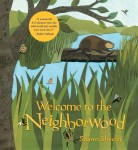
Welcome to the Neighborwood, by Shawn Sheehy; Candlewick Press, $29.99, 18 pages, all ages.

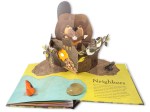
Spring is in full bloom, so why not celebrate it with this wonderful ode to the outdoors.  Shawn Sheehy, (A Pop-Up Field Guide to North American Wildflowers; Counting on the Marsh: A Nighttime Book of Numbers) paper engineer and avowed naturalist, explores seven woodland creatures such as snails, beavers and spiders, and explains how these animals are uniquely adapted to survive in their environment and among each other.  Precision and attention to detail puts Sheehy on par with Robert Sabuda, and here deftly crafts a magical world out of handmade papers. The accompanying text is informative and to the point, perfectly suited to young readers. If this book doesn’t encourage children to get outside and start exploring, I’m not sure what will. 

The Grasshopper and the Ants, by Jerry Pinkney; Little, Brown Books for Young Readers, $18.00, 40 pages, ages 2-6.

Aesop’s fable The Grasshopper and the Ants receives the Pinkney treatment in this gorgeous version of the tale. A plucky grasshopper merrily sings his way through the warm months, while industrious ants toil in preparation for lean times ahead. Here, the artist masterfully employs his usual arsenal of pencil, watercolors and ink to wondrous effect. A double-page spread in the middle of the book actually opens to a triad, where the grasshopper sits in the snow above ground while the ants below are warm and toasty.  Unlike some versions of the fable, the grasshopper isn’t left to freeze, but is invited to share his gift of song with the ants, subtly suggesting that everyone has a talent and can be helpful.

Simple, lyrical rhymes bounce along the pages, and serve as a vehicle to invite young readers to explore every nook and cranny in this richly imagined world of tiny creatures.  Informative notes detail how nature has always informed the artist’s work and the joy he derives in illustrating the world outside his window. That enthusiasm is readily apparent in every book Pinkey creates, and that spirit reaches out from the pages, beckoning young readers to share in the pleasures of nature by reading beautiful books.  

What else is there to say about Jerry Pinkney and his work that hasn’t already been said? He enjoys the distinction among his peers as being the recipient of five Caldecott Honors as well as the winner of the Caldecott Medal in 2010 for the second fable in his Aesop trilogy, The Lion and The Mouse. (I would argue that The Grasshopper and The Ants is a contender for the award in 2015.)  In addition, the artist is a five-time recipient of the Coretta Scott King Award and has been nominated for the Hans Christian Andersen Award.  

As the moral of this fable implores, don’t put off tomorrow what you can do today – share this book with little readers now. 

Seeing Spots – Thursday quickpicks

We found three picture books full of circles, spots and dots that will have readers seeing stars!


Spectacular Spots, by Susan Stockdale; Peachtree Publishers, $15.95, 32 pages, ages 1-5.

Gliding snails, snakes and slugs all have spots, and in this charming follow-up to Susan Stockdale’s Stripes of All Types readers also learn the purpose of these shapes. Large and cheerful paintings of all sorts of animals are accompanied by short easy-to-follow rhymes.  A cute matching game rounds out this sweet introduction to spotted creatures.


Spots in A Box, by Helen Ward; Templar Books, $16.99, 40 pages, ages 2-5.

British National Art Library Award winner Helen Ward’s longstanding love of illustrating charming critters (Town Mouse and Country Mouse; Varmints) continues in this story about a spotless guinea fowl. Feeling left out, the plucky bird sends away for spots of his own, and what arrives aren’t exactly what he had anticipated. Spots in A Box is a sensory feast – Ward’s tight prose and trademark watercolors are as meticulous as ever, accompanied by paper cutouts and spots that feel like pressed sequins. A tour de force.


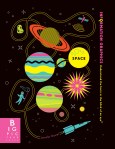
Information Graphics: Space, by Simon Rogers, illustrated by Jennifer Daniel; Big Picture Press, $17.99, 80 pages, ages 8-12.  

The latest addition to the neon-hued fact-filled Information Graphics series deals with the universe.  Seven tabbed sections cover everything from explaining the solar system to how humans explore space. Dynamic duo Simon Rogers (author of the Guardian’s Datablog) and New York Times designer Jennifer Daniel have made studying the heavens an enlightening endeavor filled with fun. 


Napoleon Sarony, photograph of Oscar Wilde. New York, 1882.
The Rosenbach of the Free Library of Philadelphia. 1954.2135

Read about a brand-new exhibit taking place in Philadelphia, on the Fine Books Blog –https://lnkd.in/dTv_6Hy