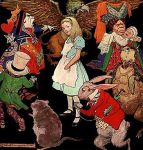


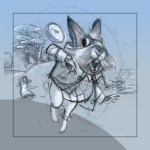
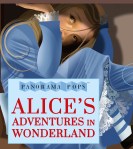
Lewis Carroll’s classic Alice in Wonderland celebrates 150 consecutive years in print, and it seems every where you look, there’s a book, exhibit, or documentary extolling the various virtues of this timeless tale. Even the British Royal Mail Service got into the spirit by commissioning a special series of stamps. The work was completed by none other than Kate Greenaway Medalist Grahame Baker-Smith. Regular readers of this site might recognize the name: In 2013 Baker-Smith illustrated an edition of The Selfish Giant (Folio Society), and we spoke then about his work. (You can read the conversation here.) Once again, the illustrator generously answered a few more of my questions and sent some stunning sketches he prepared  for this most recent assignment. Join me down the rabbit hole with Grahame Baker-Smith as we talk about inspiration, design, and illustrating a legacy.

Who was your design inspiration for Alice and the other characters? (If I may be so bold, there appears to be a family resemblance between you and the Alice character.)

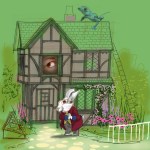
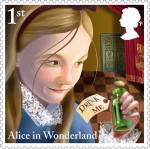
Well spotted Barbara! My ‘muse’ for Alice was my youngest daughter, Lillie. She very patiently and graciously let me take pictures of her doing things like pretending she was falling down a rabbit hole or being squished in the White Rabbit’s house – for which she had to sit scrunched up beneath my table.

Lillie is actually very dark-haired but the Royal Mail wanted a light brown hair color, so in the stamps she looks to me like Lillie but wearing a wig.

How did you choose which scenes to create?

The Royal Mail left the composition to me but had a ‘shopping list’ of scenes they wanted covered. It was a shame there couldn’t have been more than ten designs as characters like the Caterpillar and Tweedle Dum and Tweedle Dee had to be left out.

After 150 years, there’s been plenty of variations in art for the book. What’s it like tackling such a legacy?

Initially slightly terrifying! But, I reminded myself of the fact that the Royal Mail chose me for the thing that I do, so I tried to blot out everything I’d seen and play my natural game. I thought of the set of stamps as pages in a book. It was fabulous when [publishing house] Walker DID actually make them into a book. [The book is published in the United States by Candlewick Press.]

What was your work medium?

Well, everything begins with drawing, lots of drawing, in pencil, crayon, and pen. I tend to paint faces and other parts in acrylic. These are scanned into Photoshop and the rest of the design is built around it using Photoshop vector tools and brushes. I used crisp, clean shapes in Photoshop and minimal texture because of the size of the finished stamp. I needed something that would be very defined and positive at a small scale.

Did you create the pieces on a small scale, or work large and scale down?

Again this was a specific part of the brief. The printing of stamps needs to be very fine to hold the color, tones and textures at stamp-size. So the original images were 170 mm square, four times the size of the finished article. The DPI or print resolution was 600, usually 300 DPI is standard for print.

Did you read Alice in Wonderland growing up? (Or as an adult?) If so, was there a particular illustrated edition that resonated most with you? (Or not at all?)

I didn’t read Alice growing up. It’s one of those stories that, because of endless adaptations, you feel you know even if you’ve never read the book all the way through. I haven’t read it all the way through even now – I really should!

As for illustrations, Tenniel’s are so much a part of the whole legend of Alice it’s difficult to think of it without seeing his version; I also think they are marvelous illustrations anyway.

How do you perceive this story – I’ve spoken to some illustrators who viewed the tale as a whimsical fantasy, and others who saw nothing but a total nightmare, and illustrated it as such.

When I read the chapters pertaining to the scenes I had to illustrate I was enchanted by Carroll’s imagination, it seemed wild and unhinged. The feeling was of someone so in command of his literary prowess that he could conjure virtually anything into being and somehow make it work. I also felt there was an underlying truth that held it together and gave it – despite the utter madness – a gravity. It has something to say about the contrariness of people, the randomness of life and events. Characters like the Cheshire Cat seem to know so much about other people and the way the world really works while the Queen and King, with all the trappings of power, are unconscious beings who, through being unaware cause chaos and feel quite destructive and dangerous individuals.

Grahame Baker-Smith’s commemorate stamps are available through the British Royal Mail here, and the book, Alice’s Adventures in Wonderland, published by Candlewick Press, is available for $8.99.
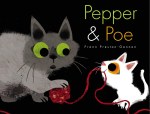

Pepper & Poe, by Frann Preston-Gannon; Orchard Books, $16.99, 32 pages, ages 1-4.

Pepper’s life is the cat’s meow: The green-eyed feline adores lazy Sundays, Mondays, and Tuesdays. Then one Wednesday, a newcomer arrives. Little Poe is smitten with Pepper, but also takes the elder cat’s toys and plays chase all the time. How does Pepper cope with the new addition? Simple high-jinks and a sleepy canine foil complete this tale of feline rivalry. This is the U.S. picture book debut for Sendak Fellowship Recipient Frann Preston-Gannon, and let’s hope there’s more to come from her. Lots of black, neon orange and chartreuse create a visually compelling story, while readers familiar with Charlotte Voake’s excellent 1997 picture book Ginger will notice a similar storyline. Both are sound choices for little cat fanatics learning how to share space and affection. 

The Little Witch, by Otfried Preussler, translated by Anthea Bell, illustrated by Winnie Gebhardt-Grayler; The New York Review Children’s Collection, $15.95, 131 pages, ages 6-9.

This spooky story is set on Walpurgis Night, or “Witches’ Night”, which takes place on April 30 in Central Germany. Legend has it that on the highest peak of the Hartz Mountain range, witches gather for an annual nocturnal revelry. All the witches attend, except for Little Witch, who, at 127 years old, is still too young to attend. (At least according to her nasty Aunt Rumpumpel.) Readers will enjoy joining the plucky little sorceress and her faithful Raven, Abraxas, who go forth and prove their worthiness of joining the group by embarking on all sorts of wild adventures. Preussler (1923-3013) continues to be one of the most popular children’s book authors in Germany, and his books have been translated into fifty-five languages. It’s easy to see the enduring appeal: Preussler writes in the tradition of the Grimms, and Bell’s translation is quick-paced and a delight to read. Longtime Preussler collaborator Gebhardt-Grayler’s pen and ink illustrations capture the humor and sensitivity of the text. This classy reissue by New York Review is sure to enchant little readers in search of unlikely heroes. A lovely Halloween treat.

Nice story this morning on NPR about the Kerlan Collection at the
University of Minnesota, a children’s literature repository of over
100,000 books, drafts and manuscripts.

In Trove Of Kids’ Book Treasures, A Glimpse Of The Work Behind The Magic

Lots of rain on the East Coast this weekend, which made me want to share this stunning retelling of the great biblical flood.  Noah’s Ark by Linda Falken (Abrams Books for Young Readers, $17.95) tells the classic story Noah and the flood, and is accompanied by stunning illustrations by Marc Chagall, Gustave Courbet and Currier & Ives. All the illustrations come from the Metropolitan Museum of Art, which collaborated in the publication. Insightful commentary provides readers with further information on the art. An ideal gift for rain-soaked pals, and a reminder that the sun will come out again soon.

Just the Ticket

Railway locomotion is a big theme for children’s books this fall, and we’ve found two coffee-table/reference guides for conductors of all ages.

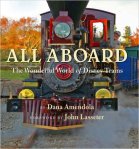
All Aboard: The Wonderful World of Disney Trains, by Dana Amendola; Disney Editions Deluxe, 192 pages, $50.00 all ages.

Perfect for fans of Disney history and railway enthusiasts, this lovely oversize compendium chronicles how trains have always held a prominent place in Disney lore – Walt himself was a lifelong admirer of locomotives, and even worked aboard the Missouri Pacific Railroad as a teenager. Disney incorproated trains into many of his animations – Mickey Mouse’s first appearance on a train was in a black and white short called “Mickey’s Choo-Choo” in 1929. Trains continue to figure prominently in Disney films, and engines including the Fort Wilderness Railroad, the Monorail, and the Disney Express are just a few  that dot the various parks throughout the world. Clocking in at just under 200 pages, there’s enough train trivia in All Aboard coupled with Disney lore to keep readers happy for hours.

Iron Rails, Tough Men, and the Race to Link the Nation: The Story of the Transcontinental Railroad, by Martin W. Sandler; Candlewick Press, $22.99, 224 pages, all ages. (A Junior Library Guild Selection)

In 1845, Asa Whitney (a relative of cotton-gin inventor Eli Whitney) went to Congress to propose a transcontinental railroad, but the lawmakers rejected the bill, mostly due to backbiting and squabbling over who would most profit from the endeavor. (Sound familiar?) The country would have to wait until 1862, when Abraham Lincoln signed the Pacific Railway Act that authorized two companies to build railroads linking the Atlantic and Pacific coasts, thereby thrusting America into the modern era. Pulitzer-Prize nominee Martin Sandler presents all the moving parts in this six-year saga clearly and in wonderful detail, and doesn’t skimp on the intrigue and greed found at every level of the project. Still, there’s a palpable understanding among everyone involved that these 1800 miles (all laid mostly by hand), were an historic moment and great change was coming to the country, one rail at a time. Thoroughly researched, including a timeline, notes, sketches and photos, this volume will long remain an invaluable and entertaining resource for research projects on the American West and Reconstruction periods.

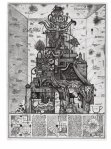
(via Paper Architects Draw the Unbuildable, Inspire the World – The Fine Books Blog)

Gone to the Dogs
Two middle-grade readers for kids who know that dogs are loyal to the end. 

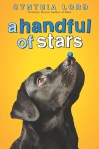
A Handful of Stars, by Cynthia Lord; Scholastic Press, $16.99, 184 pages, ages 10-13.

Every summer, migrant families travel from as far as Mexico to harvest blueberries in a remote part of Downeast Maine, and local residents generally don’t interact with them. That is, until one afternoon, when Lily’s blind retriever Lucky runs away and into the blueberry fields. Salma Santiago lures the dog back with her peanut butter sandwich, and from that moment on, Lily and Salma become friends. Salma wants to enter the Blueberry Queen pageant, but does she have the courage to do it? Newbery Honor Author Cynthia Lord (Rules) tackles such themes as prejudice, courage, and friendship with compassion and grace, and as a Maine resident herself, descriptions of this wild and wonderful area of New England are wonderfully accurate.

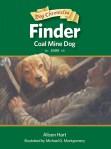
Finder, Coal Mine Dog, by Alison Hart, illustrated by Michael G. Montgomery; Peachtree Publishers, $12.95, 181 pages, ages 7-10.

In 1909, 259 coal miners died in a tunnel fire in Cherry, Illinois, becoming the third most deadly mine disaster in U.S. history. In this fictionalized thriller, readers meet Finder, a dog who pulls a cart in those dangerous mines. His young owner Thomas works too, trying to pay off his deceased parents’ debts. Soon enough, fire breaks out, and the unlikely duo find themselves in a race against time to save fellow miners. Told from the point of view of the dog, Alison Hart’s latest canine thriller in her Dog Chronicles series is action-packed, while also offering children a look at what life was like for children and their pets in America a century ago. Michael G. Montgomery’s pen and ink illustrations capture the fast pace of the tale. A map of the mine, notes about the actual fire, mining, child and animal labor bring this poignant moment in American history to life.