It’s a crazy time of year, and I have a feeling most of you have little time to spare for reading reviews right now, so I’ll get right to it: Herewith, a list of this week’s best books, for kids from one to 92. Enjoy!
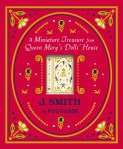
Miniature Treasures from Queen Mary’s Dolls’ House: A Sherlock Holmes Story: How Watson Learned the Trick, by Sir Arthur Conan Doyle; and J. Smith, by Fougasse; Candlewick Press, $25.00 each, all ages.
These miniatures are facsimiles of books in the library of Queen Mary’s Dolls’ House. (Check out the Guardian’s 2010 story about the miniature building and its contents.) While the originals remain on display at Windsor Castle, these tiny replicas are beautiful jewels available to everyone.
Frozen Wild: How Animals Survive in the Coldest Places on Earth, by Jim Arnosky; Sterling Children’s Books, $14.95, 32, pages, ages 6-10.
Award-winning author and illustrator Jim Arnosky has dedicated a career to crafting children’s literature with a focus on the natural world, and his latest offering doesn’t disappoint. Five stunning foldouts reveal where otters, beavers, penguins, and other creatures survive during the coldest months of the year, and points out animals most of us might see in our own backyards. A must-have for the budding naturalist. (Check back in a few weeks to read my interview with Arnosky!)
An A from Miss Keller, by Patricia Polacco; Putnam, $17.99, 40 pages, ages 5-8.
If you want to give a great gift to a teacher this year, make sure that An A From Miss Keller is in your child’s classroom or school library. “If anyone opens the world up to children, it is teachers,” says beloved author-illustrator Patricia Polacco, and in her sixth homage to educators (Thank You Mr. Falker is now an established schoolhouse classic), readers meet young Tricia, a nervous student in “Killer Keller’s” writing class. A sudden loss leaves the child feeling adrift, but Miss Keller helps Tricia channel those emotions into a powerful personal narrative. Don’t be surprised if you start tearing up while reading this one.
Why should kids have all the fun this holiday season? It’s easy to forget the grownups during this hectic time of year, and checking off everyone on your list can get pricey. Consider giving the gift of great literature without breaking the bank: The Folio Society recently released a new series called Folio Collectibles, with four classic English-language titles (A Christmas Carol, The Hound of the Baskervilles, Gentlemen Prefer Blondes and Frankenstein) produced especially for the lineup. Why these books? “We wanted to chose popular classics that everyone should have in their library across a range of genres, said Vicky Traino, Folio Society spokeswoman. “We think that they are the perfect gift to yourself or to introduce someone to the joys of books from The Folio Society.” I’m reading Doyle’s chilling crime caper, The Hound of the Baskervilles, complete with linocut reproductions by English artist and printmaker Edward Bawden (1903-1989), who was commissioned by the Folio Society in 1987 to produce six illustrations for the book. Perhaps as exciting about the Collectibles is their price: each soft-covered, flexibound volume retails for $34.95, and perfectly sized to tote around.
Most Folio Society editions are works of art in their own right, and, at least in my house, are handled with kid gloves. The Collectibles series easily lend themselves to cozying up by the fire, book in hand, and reveling in the joys of the season. Interested? Better act fast: Holiday order deadlines are December 9 (today) for regular delivery; December 14 for express.
Abigail watching Jan Brett sign THE TURNIP at November 28 signing.
Brett created this sketch in less than 40 minutes, and donated it to the Northborough, MA Wegmans.
On Saturday November 28, while a chilly rain fell outside, beloved author and illustrator Jan Brett arrived at the Northborough, Massachusetts Wegmans market in her massive tour bus and talked about the inspiration for her latest book, The Turnip, while also offering young fans a drawing tutorial.
A group of nearly four dozen children waited eagerly in a roped-off area of the market, surrounded by seasonal holiday items, while parents stood in the nearby dairy section. Brett arrived wearing turnip colors: a purple-velvet blazer with a jade green rooster brooch and banana-yellow pants. A Hedgie the hedgehog purse draped across her shoulder, holding the Prismacolor translucent markers that would be employed later in the program to create Badger Girl, one of the characters in The Turnip. Brett’s husband, Boston Symphony Orchestra Bass player Joseph Hearne checked Brett’s microphone and set up her easel.
Before the art demonstration, Brett introduced her husband and her pets, a rooster and a chicken who travel with her wherever she goes. The poultry were surprisingly calm and appeared unfazed by the throng of people. Next, she discussed the inspiration for this book. She and Hearne had traveled to Russia, and upon passing a rural farm, Brett was reminded of a folk tale where peasants attempt to unearth a giant turnip. “I loved the story, but why not turn the peasants into a family of badgers?” she explained to the children. “I think badgers are so expressive, don’t you?” The children, who, until that moment had been transfixed into silence, heartily agreed. Brett started outlining the face and body, and then stopped. She told the group that children often write to her asking how to draw expressions, and she always told them that the eyes are the most important feature. “I have a mirror next to my easel, so that I can make faces and sketch what I see.” To demonstrate, Brett covered her face, leaving only her eyes visible. Happy, mad scared–the children guessed correctly each time.
After adding the badger’s body parts, Brett added color, all the while offering tips on shading and outlining. Though this single sketch took less than forty minutes, Brett acknowledged that a single page spread often requires a week of steady work. “I know I’m finished with a drawing when I feel as though I could jump right into the page,” she said. The New York Times bestselling author offered encouragement to the group too. “To get better, you must draw, draw, draw! And be sure to sign and date your work, so that you can follow your progress.” Though some children may lament that their work doesn’t come out looking like Brett’s, she insisted that budding artists stick to it. “The more you draw, the better you get.”
Brett signed copies of The Turnip after her demonstration. Wegmans staff organized fans by ticket number, and though lines snaked through the aisles, order reigned. My daughter and I waited patiently with my mother, a longtime Brett fan who had orchestrated the outing, and when we reached the signing table, the author charmed us with her sweet inscription. Naturally, we had toted along a second book, The Night Before Christmas, which Brett happily inscribed as well, adding a reindeer portrait alongside the date.
Famished, my daughter inhaled a slice of pizza after the book signing. As I waited in line for a cup of coffee, I spoke with a woman I recognized from the event. She brought her seven year old son, though they had just moved from Virginia days before Thanksgiving and were still unpacking. “My son will only read Jan Brett books. They’re magical. So we had to come,” she explained. Another woman, a teacher at Seven Hills Charter School in nearby Worcester, brought eleven of her 21 students, and raised funds so that every child in her class could have their own copy of The Turnip. “Jan [Brett] has a way of inspiring and encouraging these children. It means so much to them.” Powerful words to remember during this holiday season, when we’re bombarded with ads for gadgets we don’t really need, and when children are so easily distracted by gimmicks and flashing doo-dads. Books, beautiful books, are magic.
The Turnip, by Jan Brett; Putnam Books, $17.99, 32 pages, ages 4-7. (November 2015)
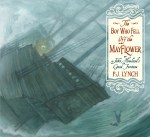
The Boy Who Fell Off the Mayflower, or John Howland’s Good Fortune, by P.J. Lynch; Candlewick Press, $17.99, 64 pages, ages 7-10.
Here’s a Thanksgiving story that fully examines the adventure, faith, luck, and unity that defined the Pilgrims’ early days in America. Award-winning author and illustrator P.J. Lynch’s latest children’s book focuses on the life of John Howland (c.1591-1672), an indentured servant who sailed aboard the Mayflower and eventually became the executive assistant to John Carver, New Plymouth County’s first governor. Told in the first person, the fictionalized account of Howland’s crossing takes on a dramatic sense of urgency–England’s Separatist church members (they weren’t pilgrims yet) were being jailed and harassed, and though they had found religious asylum in Holland, church members feared a war with Spain would again put their community in peril.
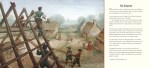
Lynch details a journey that seems doomed from the get-go (the Mayflower’s sister ship, the Speedwell, never even crossed the Atlantic), and at times it looks like the group won’t make it. (Re-read the title. Howland actually fell off the Mayflower during a storm. That historical nugget inspired Lynch to write the book.) Though originally headed for Virginia, fierce storms bobbled the ship two hundred miles off course, to Cape Cod, where the weary travelers set ashore, where another adventure of survival awaited. Lynch’s gouache paintings expertly capture both the squalor of London and the wilderness of New England. (This is the first book Lynch has both written and illustrated.) Samoset, Squanto, and the great Wampanoag sachem Massasoit are also richly rendered, highlighting the peace these groups enjoyed throughout Howland’s long life. The feast scene is particularly warm, especially after reading about the unforgiving first winter. (Nearly half the settlers died, and lodgings were little more than canvas stretched wooden frames.) The Boy Who Fell Off the Mayflower also provides surprisingly relevant food for thought in our current debates over refugees seeking religious asylum. The author’s notes and bibliography offer further resources for learning more about this pivotal moment in history.
copyright 2015 Coralie Bickford-Smith. Reproduced with permission from Penguin Books.
copyright 2015 Coralie Bickford-Smith. Reproduced with permission from Penguin Books.
Coralie Bickford-Smith is the design mastermind behind many of the stunning covers of Penguin’s clothbound Hardcover Classics series. Now, she has written and illustrated her own book, The Fox and The Star (Penguin Books Hardcover Original; $20.00, published November 10), a timeless tale of an unlikely friendship and courage in the face of hardship.
The book’s production values are exquisite–printed in Italy on creamy, uncoated, Munken Pure Rough paper and bound with bright orange thread, Bickford-Smith’s intricate designs recall the work of English textile designer William Morris. The Fox and The Star has all the trappings of a modern classic, the result of Bickford-Smith’s unrelenting quest for perfection. It is a delight to behold and to read.
Bickford-Smith spoke with me recently about writing and illustrating her own story, and how the process of putting the book together was as important as the words that fill the pages.
How did you come up with the story?
The story had been in my mind’s eye for a number years and the dream was always to make it into a book when the time was right. I wanted to distil my own experiences of life, lessons that I have learnt, into a simple story. I like the idea of turning life’s tough times into beauty.
Could you talk about the design process for The Fox and The Star? (I imagine foil-stamping on cloth boards posed its own set of challenges.)
After the basic storyline had been agreed on, I had to get it to fit into the required amount of pages, decide how to illustrate it to create tension and pace as the book was read. Then it was about drawing and sketching out ideas for page layouts and creating dummies of the book. The process was a constant back and forth to see what should be improved, words were changed right up until the last minute before printing. As I did all my own design and art working it was an immensely involved process. The cover foiling was perfectly reproduced, we worked with the most amazing printer and this was the one area in which I knew I could be certain of producing well. My biggest battle was with my own self-confidence about whether I could produce something worth reading.
What was different (if anything) about designing and illustrating your own book?
It was a big departure for me to create an entire book instead of just visualizing and housing an author’s words, so everything felt different. I had never created a narrative visually or told a story through my illustration. For book covers I usually create symbolic elements and pattern to create a sense of the narrative contained within a book. The same skill set can seen see throughout pages of The Fox and The Star but I didn’t want to rely too heavily on this. A story needs to be told and narrated not just decorated. There was a lot to learn and consider. It was exciting to have a totally new challenge. I know that there is still much for me to learn about storytelling.
You studied Typography and Graphic Communication at Reading University. What drew you to the art of arranging type and the world of book design?
I had always been drawn to this area of creativity. Obsessed by books from a young age, constantly drawing my own type faces. It was not until I went to Reading University for my interview that I really felt that there was a place in the world for me to fit into. All my passions suddenly made sense and I was happy to be surrounded by like-minded people. It was instantly apparent that I absolutely had to study at Reading.
Your Penguin Hardcover Classic Clothbounds are considered by many to be modern collectibles. Where do you find your inspiration?
Much of my inspiration comes from looking backwards in history. Design rules are timeless. William Morris, William Blake, Rockwell Kent, Edmund Dulac and Audrey Beardsley are big influences, to name a few. This inspiration also naturally fed into The Fox and The Star. I was so eager to do an entire book from start to finish. I love the craftsmanship from the arts and crafts movement. Everything had meaning and was created with passion for the medium used. I feel that today we are becoming more and more separated from the process of creating. I want my work to be as lovingly considered as the words inside.
What was your medium for illustrating the interiors?
All my ideas come to me by drawing on paper. When something strikes me as exciting, I draw it to scale and use coloring pencils to create energy and excitement. I draw and draw until I get things right and then I take it into the computer so that it can be colored and made ready for press. I loved the fact that I controlled every aspect of the process. From writing to the drawing to the intricacies of file separation for the plates that go on to the printing press to print the right colors.
The paper stock is lovely – did you have a say in selecting it?
Yes, that paper is lovely. It is my favorite paper stock – Munken Pure Rough. I had a say in all the materials used to produce the book, right down to the orange thread that was used to sew the pages together. How the book was produced was as important to me as the story. I was lucky to be working with people that appreciate how important these elements of book design are to me.
What are you working on now?
After my time away from my Penguin day job, working on The Fox and The Star, I am once again knee-deep in Penguin classic fiction cover design. Its a bit of a treat to be back in my comfort zone again but I have a new story that is bouncing around my head so I really must start entering the zone of the unknown again.














 Literary Features Syndicate