Shared with Dropbox
Nicole Claire looks at a collection of short stories for young adult readers.
My True Love Gave to Me, edited by Stephanie Perkins; St. Martin’s Press, $18.99, 321 pages, ages 12 and up.
Shared with Dropbox
Nicole Claire looks at a collection of short stories for young adult readers.
My True Love Gave to Me, edited by Stephanie Perkins; St. Martin’s Press, $18.99, 321 pages, ages 12 and up.
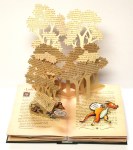


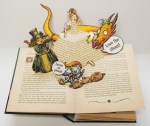
The Dragon & the Knight: A Pop-up Misadventure, by Robert Sabuda; Little Simon, $29.99, 22 pages, ages 5-up.
Master paper engineer Robert Sabuda has created another book sculpture for pop-up enthusiasts of all ages. In this volume of fractured fairytales, a brave (if slightly goofy) knight pursues a maligned and misunderstood dragon. The duo escape from their story and onto the pages of other fairytales, ranging from Aladdin to Cinderella. The escapees wreak havoc on each tale they visit, while each page reveals a more complex and imaginative three-dimensional creation than the last. While there is text on each page, it’s not really here to be read. Rather, it demonstrates the ruckus caused by the intruders – fairytales are obscured by towering structures of fire-breathing dragons, and even some of the characters pop-up sheathed in outfits made of words. (See Cinderella’s dress and Aladdin’s flying carpet.) Sabuda paper art books makes stunning gifts, but they are delicate – with so many intricate folds and pleats, very young readers should be supervised, lest older readers wish to spend hours carefully refolding dragon tails and towers. This tour de force will make an excellent addition to any collection on paper engineering.
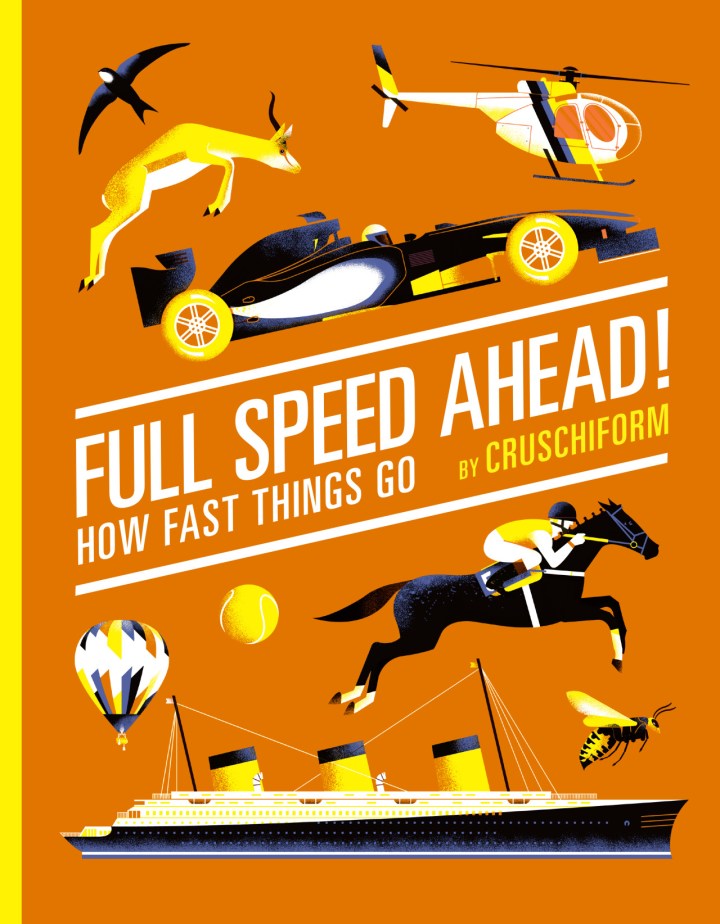
Full Speed Ahead! How Fast Things Go, by Crushiform; Abrams Books for Young Readers, $18.95, 64 pages, ages 4-8.
This bright and zippy book compares the speed of movement for various animals and transportation. For example, at 50km/h (30 mph,) a blue whale coasts along at the same rate as a cargo ship, while the Apollo 11 spacecraft cruises alone at 40,000km/h (25,000 mph). In each spread, the rate of speed is given in huge type on the left, and is accompanied by an equally bold image on the right, and the rate of speed increases incrementally. (The speed is given first in kilometers, then in miles per hour in slightly smaller size.) Originally published in French under the title À Toute Vitesse, Parisian-based Cruschiform studios created the bold illustrations using spot color printing technique. Similar to screen painting, spot color printing was used by artists in the 1950s to reproduce images, and here, the bold colors and retro illustrations are eye-catching and easily accessible to young readers. The glossary includes further information about the moving objects, as well as a definition of speed. It is a perfect introductory picture dictionary for little speedsters. Onward and upward.



The Winter Train, by Susanna Isern, illustrated by Ester Garcia; Cuento de Luz, $16.95, 24 pages, ages 2-5.
The first snowflakes send many of us for warmer climes, and the animals in The Winter Train are no exception. The Northern Forest inhabitants prepare to escape the annual freeze, packing their toothbrushes and turning out the lights. It seems everyone makes it onto the train, except they’ve forgotten their pal Squirrel. Friends stick together in Susanna Isern’s tale full of grace and solidarity, while Jon Brokenbow’s faithful translation retains the sonorous, read-aloud quality from the original Spanish version, Tren de invierno. Ester Garcia’s renderings of partriges, hedgehogs and ferrets are cozy and endearing. As these animals of the Northern Forest know, kindness and generosity are the nicest gifts of all.
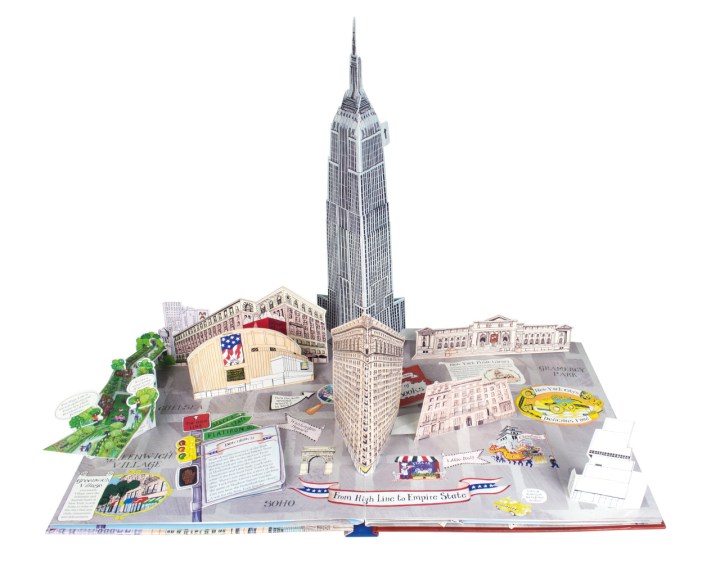
POP–UP NEW YORK. Copyright © 2014 by Jennie Maizels. Reproduced by permission of the publisher, Candlewick Press, Somerville, MA on behalf of Walker Books London. The image of the Flatiron Building is a tradmark used under limited license. The Empire State Building image ® is a registered trademark of Empire State Building Company LLC. and is used with permission.
Pop-up New York, by Jennie Maizels, Candlewick Press; $19.99, 12 pages, all ages.
Forget the ubiquitous I LOVE NY tee shirts because there’s a better way to show your love for the Big Apple that also makes a great holiday gift; Jennie Maizels’ latest oversize pop-up book dedicated to New York. (London was the object of her previous pop-up ode to urban life.) Here readers are treated to marvelous paper engineering showcasing many of the places that make New York unique, such as the Statue of Liberty, the Empire State Building, Yankee Stadium, and the High Line. Each oversize page is filled with fact-filled flaps for further exploration. Where many pop-up books of this size and scope can cost close to thirty dollars, Pop-up New York delivers great value as a statement-making present and can be found for less than $20. If you can’t make it to New York this holiday season, bring it home instead – there’s no place like it.


Jon Klassen on Making Art for Kids
In July I spoke with Caldecott and Greenaway Medal winner Jon Klassen (This is Not My Hat) about his most recent project, a collaboration with writer and longtime friend Mac Barnett called Sam and Dave Dig a Hole. (Candlewick, $17.99) We talked about teamwork, tone, and teaching life’s lessons through thoughtful and deliberate illustration.
Klassen first worked with Barnett on the Caldecott Honor winner Extra Yarn, and was excited to reunite professionally for Sam and Dave Dig a Hole. “When Mac wrote Extra Yarn, he wrote with my artwork in mind. For example, ‘The town was covered in soot,’ was just for me, because he knew how much I like to make splattery, dusty art. There were many little favors like that in the book.” There’s more dirt here, where Klassen’s restrained, quirkily stiff characters dig for buried treasure alongside Barnett’s spare text, creating a superb interplay of text and art. Still, Klassen was nervous about drawing humans. “I don’t draw people very often – I usually avoid them because people are supposed to be cute.“ (Think of his larcenous critters in This is Not My Hat and I Want my Hat Back.) Here, the boys dig in search of treasure, but miss hidden gems at every turn, and often by mere inches. Their faithful dog frequently sports a pained look on his face, sharing the readers’ understanding that the boys are just barely digging past something extraordinary.
Both Barnett and Klassen have similar ideas about the tone they want to set for any given project, and that may explain why their books have a seamless quality about them. “Mac understands why I like things to be a certain way, and he backs that up with text. As an illustrator, it’s nice to work with someone who meets you in the middle.”
While Barnett wrote Sam and Dave Dig a Hole, Klassen was already sketching. He created an image where the boys separated, digging tunnels at either end of a page, while a massive jewel remains hidden between them. Barnett hadn’t written that scene yet. When Klassen showed him the drawing, the story changed to accommodate the art. “We designed the book so that wherever the boys were digging on the left spread, the text would line up with them in space on the right spread. I thought about what would happen if the boys split up, and if the text followed suit.” Initially, Barnett hesitated because he felt it might be traumatic for the readers if the boys separated, then realized that this could become the pivotal moment in the tale. “This became a big deal. I like when you come at an idea with a neat design, and then you ask what the emotional implications of this idea will be.” The separation brings an actual dilemma, yet the boys push on with surprising strength and resolve. (Spoiler: they miss the gem again, but it’s a great sight gag. A nap, hidden bones, more dirt and a plunge through space follow.)
Klassen’s art is deceptively simple – his colored pencil drawings give the gems, the boys, even the dog, a scratchy, zig-zaggy, dusty quality. Children might be tempted to recreate those characters, much like Mo Willems’ Pigeon is so often imitated by little artists. “These are very simple drawings. Kids appreciate simplicity, something that looks attainable,” said Klassen. And while many illustrators are capable of creating sophisticated, complex works of art, Klassen argues that isn’t the goal for children’s picture books. “I don’t think it’s the job of an illustrator to show off. The point is to tell a story to kids. If you look at anything by P.D. Eastman, for example, the art isn’t showy, but it’s so well staged. Eastman was solving so many problems on the back end before he even started drawing. Some of his books are strange and complicated, but they work.” The challenge lies in tackling big problems with clear text and artistry. Done well, an author can tackle difficult emotional topics through accessible storytelling and illustration.
Despite earning numerous laurels from the publishing industry, the media, and fellow illustrators, Klassen remains what he calls ‘a nervous artist.’ Having grown up on classic picture books like those by P.D. Eastman and Arnold Lobel, Klassen says the bar is set pretty high. “I can’t get away from being nervous about it. These can become revered treasures for children. It’s hard to completely understand the things these books are supposed to do, and the importance they can have in kids’ lives. So there’s a massive amount of anxiety for me, because I know how special these books can be. When I see books that got it right, it’s wonderful.”
image©2011 Karina Schaapman, photo by Ton Bouwer. Reproduced with permission from Dial Books.

The Mouse Mansion, written and created by Karina Schaapman, photographed by Ton Bouwer; Dial Books, $18.99, 60 pages ages 5-8.
Usually when there’s a mouse in the house, the human inhabitants run for the hills. Here, debut children’s book author Karina Schaapman created a home just for those furry creatures. Her six foot wide, ten feet tall, hundred-room mouse mansion is made of cardboard boxes and paper mâché, and each room is filled with to the brim with all the trappings one would expect in a home – diapers and formula in the nursery, armoires overflowing with tiny undergarments, bookshelves bursting with miniature versions of Charlotte’s Web and Winnie the Pooh. The carefully shot photographs are by Ton Bouwer, and the folio-size pages allow for careful examination of each object.
This mansion isn’t for ritzy city murines; it gives off a warm, nubby, cozy feel, and the accoutrements appear pulled from a romp through an attic that hasn’t been touched since 1970. Families of gray and white cloth mice live here, and two young friends, Sam and Julia, scamper from room to room in search of adventure and fun. There’s laundry to sort, a bakery to visit, and even a Friday night Sabbath to attend, complete with a tiny table covered by challah, candles and wine. Schaapman’s detailed artwork is accompanied by thoughtful and informative text, and though the book clocks in at 60 pages, each chapter can easily be read as a unique tale. Pouring over the abundant detail on each page will captivate readers of all ages, and makes an excellent reading choice for snuggling up and spending a wintry afternoon with little readers.  image©2011 Karina Schaapman, photo by Ton Bouwer. Reproduced with permission from Dial Books.

image©2011 Karina Schaapman, photo by Ton Bouwer. Reproduced with permission from Dial Books.
The Mouse Mansion, written and created by Karina Schaapman, photographed by Ton Bouwer; Dial Books, $18.99, 60 pages ages 5-8.
Usually when there’s a mouse in the house, the human inhabitants run for the hills. Here, debut children’s book author Karina Schaapman created a home just for those furry creatures. Her six foot wide, ten feet tall, hundred-room mouse mansion is made of cardboard boxes and paper mâché, and each room is filled with to the brim with all the trappings one would expect in a home – diapers and formula in the nursery, armoires overflowing with tiny undergarments, bookshelves bursting with miniature versions of Charlotte’s Web and Winnie the Pooh. The carefully shot photographs are by Ton Bouwer, and the folio-size pages allow for careful examination of each object.
This mansion isn’t for ritzy city murines; it gives off a warm, nubby, cozy feel, and the accoutrements appear pulled from a romp through an attic that hasn’t been touched since 1970. Families of gray and white cloth mice live here, and two young friends, Sam and Julia, scamper from room to room in search of adventure and fun. There’s laundry to sort, a bakery to visit, and even a Friday night Sabbath to attend, complete with a tiny table covered by challah, candles and wine. Schaapman’s detailed artwork is accompanied by thoughtful and informative text, and though the book clocks in at 60 pages, each chapter can easily be read as a unique tale. Pouring over the abundant detail on each page will captivate readers of all ages, and makes an excellent reading choice for snuggling up and spending a wintry afternoon with little readers.

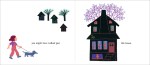

Mr. Cornell’s Dream Boxes, by Jeanette Winter; Beach Lane Press, $17.99, 40 pages, ages 4-8.
Jeanette Winter’s latest biographical picture book (Biblioburro: A True Story from Colombia; Malala, a Brave Girl from Pakistan) is about Joseph Cornell, a twentieth-century artist and sculptor based in Queens, New-York. He was famous for creating collages and three-dimensional artwork called assemblage, where he filled handmade boxes with his artwork and found objects. Cornell also had a soft spot for children, and at his last exhibit, held at the Cooper Union School of Art and Architecture in 1972, Cornell instructed the curators to hang his artwork three feet from the ground so that children could better see the tiny worlds Cornell created. Spare, precise text accompanies dreamy, somewhat surreal images of dancers in snow, pipes blowing soap bubbles, and frosty pink cupcakes. Despite being restrained by two dimensions, Winter’s renderings provide a surprising perception of depth, and are alive with colors, shapes and patterns. This is an inviting and magical exploration of an artist who created dream worlds wrought miniature. Art enthusiasts of all ages may be inspired to create their own memory boxes and dream of fantastic places much as Cornell once did.
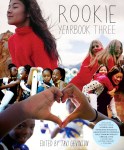
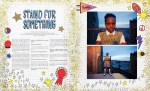
Rookie: Yearbook Three, edited by Tavi Gevinson; Razorbill, $29.95, 358 pages, ages 12-18.
As an eleven year old with a penchant for dying her hair gray and defying wearing what can perhaps be described as granny attire, Tavi Gevinson launched her fashion blog StyleRookie in 2008. Since then she has held a firm grip on the hearts and minds of her readership and has recently branched out from observing the catwalk by founding a new website where she explores, celebrates and commiserates all that goes into being an adolescent girl in contemporary society. Rookie: Yearbook Three is the latest installment in a trio of volumes showcasing the best and most powerful contributions to Gevinson’s latest online magazine RookieMag.com.
Rookie: Yearbook Three does resemble that high-school rite of passage, minus the stuffy leather hardcover and black and white pages. It’s folio size, and entries start with July 2013 through May 2014, with articles for each month corresponding to a given theme. (For example, October 2013’s topic was appropriately entitled “Haunted.”) Gevinson’s team includes dozens of energetic young writers, photographers and illustrators who provided thoughtful, witty and nuanced work. Look for some star-studded names in the contributor list, like the Fanning sisters, Lorde, and Shailene Woodley.
There’s nothing here that speaks down or demeans readers, nor is there any duplicity sometimes found in more mainstream magazines aimed at the 13-18 female demographic, where an uplifting story on body acceptance might be followed by a photo spread showcasing girls as vapid eye-candy. The book and website’s eponymous titles refer to what Gevinson believes is a shared experience among her audience and her staff; everyone is figuring out life as they go along, but members of this particular community navigate the twisted road to adulthood together, possibly arriving with a greater arsenal of self-acceptance and self-confidence than generations prior.
Rookie: Yearbook Three would make an excellent and most appreciated gift to any teenage girl. Perhaps parents would do themselves a favor and read it too – at an age where most children would rather die than sit down and talk with adults, this book offers insight on today’s youth, and it’s pretty inspiring. If Gevinson has her way, there’s likely a Book Four in the works to round out the entire high school experience, and we’re eager to see what’s next.
 Literary Features Syndicate