
Forthcoming Biography of W.A. Dwiggins Gets the Kickstarter Treatment – The Fine Books Blog

 Source:
 BE QUIET!

BE QUIET! by Ryan T. Higgins; Disney-Hyperion; $17.99, 40 pages, ages 3-8.
Rupert the mouse has a dream: to craft a beautiful, wordless picture book. His ideas are grand, but when his friends hear about the project, they interject. A lot. And come up with all sorts of ideas. Unfortunately, brainstorming requires…talking, and poor Rupert quickly loses his cool, while his credibility as an artistic know-it-all slowly loses its veneer in perfectly paced slapstick. Clearly, this is not going to be a wordless picture book, but Rupert’s going to give it everything he’s got–even at the expense of his lofty sensibilities. The book is sure to be a hit with preschoolers, but offer BE QUIET! to a first- or second-grader to read aloud, and watch the hilarity ensue. The creator of Mother Bruce knocks it out of the park once again with another wacky menagerie of characters while also cleverly engaging adults with definitions of onomatopoeia, visual stimulation, and most importantly, irony.
Promenade in Paris Highlights Medieval Book Trade – The Fine Books Blog
“Show Me the Mini” Exhibit at Harn Museum is Full of Tiny Treasures – The Fine Books Blog
 Source:
 Mrs. White Rabbit
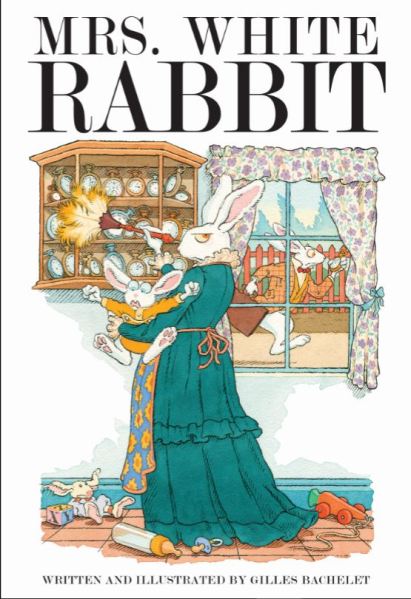
Mrs. White Rabbit, by Gilles Bachelet; Eerdmans, $17.00, 32 pages, ages 6-10.
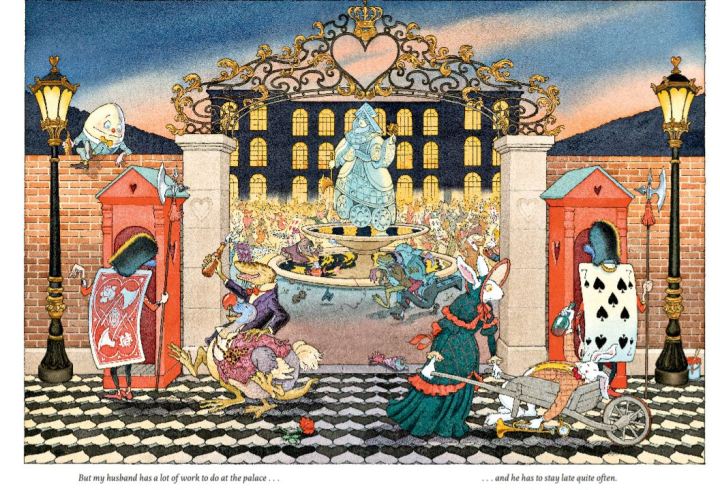
Mrs White Rabbit has her paws full: caring for a household overrun with a warren of rambunctious bunnies, tending to the needs of her time-strapped husband, the White Rabbit, and entertaining the oddball visits of a size-shifting girl named Alice has left the family matriarch feeling sullen, stressed, and neglected. It turns out today is her birthday, and her distracted husband has forgotten all about it. Mrs. White Rabbit vents her daily drama in diary format, giving readers a behind-the-scenes look at life in Wonderland for the White Rabbit’s better half. Gilles Bachelet’s humorous look at leporidine domesticity is accompanied by his equally witty illustrations of bunnies at play, and causing mischief, all under the perennially peeved gaze of Mrs. White Rabbit. Could any family expect tranquility when taking up residence in Wonderland? Besides, it seems all Mrs. W. really wants is a little R-E-S-P-E-C-T, and who can’t relate to that?
Originally published in French as Madame le Lapin Blanc, this cheeky twist on Lewis Carroll’s classic is a quirky reminder that it takes a village to raise a family, and though everyone is busy these days–replace the White Rabbit’s clock with a cell phone and he’d blend in perfectly with any number of daily commuters–we’ve got to make time for our loved ones, too.
Rise of the Centaur: A History of a Typeface – The Fine Books Blog

A Tale of Two Roosevelts

My latest review for High Country News examines two books that explore how Theodore and Franklin Roosevelt championed environmental awareness in America, even when it was mighty unpopular to do so: http://bit.ly/2mDXUbL
The Forbidden Fruit of an Elephant’s Garden
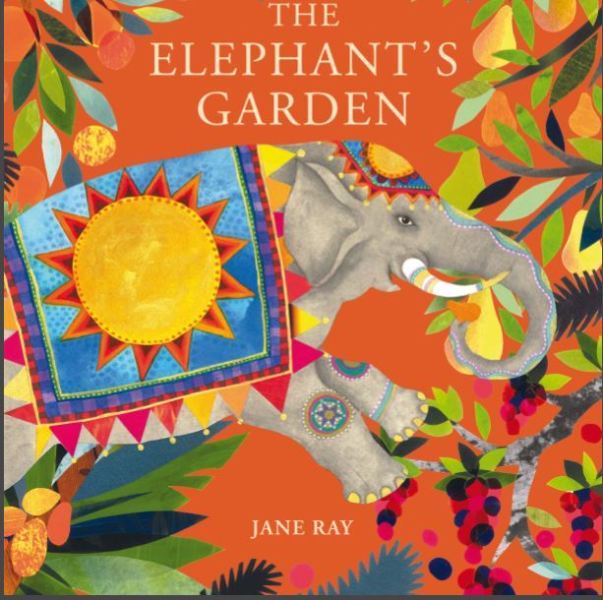
The Elephant’s Garden, by Jane Ray; Boxer Books, $14.95, 32 pages, ages 2-6.
Many cultures have their version of the garden thief story–Russian folklore tells of Tsarevitch Ivan whose golden apples are stolen by the mythical Firebird, and food theft leads to a most unhappy ending in Nankichi Niimi’s powerful Gon, the Little Fox (1932). And of course, there’s the biblical tale of the snake tempting Eve with a forbidden apple in the garden of Eden. These aren’t those effortlessly cheerful happily ever after tales–these are stories of greed, failure, and attempts at redemption, with varying degrees of success, and Jane Ray’s retelling of a traditional Indian folktale follows in that tradition.
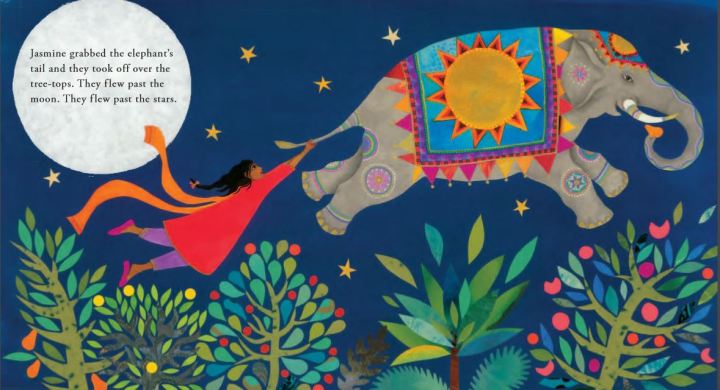
Here, a little girl named Jasmine discovers a brightly festooned elephant stealing from her garden, and once confronted, the elephant explains that the fruit in his garden is inedible. To prove it, he whisks the astounded child to his faraway cloud garden, where massive kiwis, strawberries, and peaches fill every corner, but sadly, they’re only precious jewels and of no use to a hungry elephant. Upon returning home, Jasmine tells her family about the magnificent sky garden and though she begs them not to tell anyone, the whole village finds out about the elephant’s treasures. What follows is a surprisingly elegant exploration of greed and selfishness. Ray’s vibrant, jewel-toned, collages evoke a lush Indian fantasy world, and the double-page spread of Jasmine grasping the tail of the elephant recall’s a similar nocturnal flight in Joanne Ryder and Amy Schwartz’s Night Flight or any of Henri Rousseau’s jungle scenes.
A worthy addition to any folktale collection, The Elephant’s Garden subtly invokes Ghandi’s summation on avarice: “Earth provides enough to satisfy every man’s needs, but not every man’s greed.”
Pretty Birds

Check out this pair of sweet bird books that will have your little chicks peeping with joy:
Jump, Little Wood Ducks, by Marion Dane Bauer, photographs by Stan Tekila, Adventure Publications; $14.95, 32 pages, ages 1-4.
Wood ducks are perfectly named because they nest in the holes of trees. Though safe from certain predators, freshly hatched ducklings can’t fly yet, and getting out of the nest requires a real leap of faith, since some nests can be thirty feet high. Newbery Honor winner Marion Dane Bauer’s latest children’s book imagines the conversation between a mother wood duck and her anxious chicks as they survey their first real challenge. Nature photographer Stan Tekiela’s high-resolution images of wood ducklings are highly entertaining and encourage in-depth examination.

Blue Penguin, by Petr Horacek, Candlewick Press; 15.99, 32 pages, ages 1-6.
Petr Horacek has built a career sketching adorable parrots, geese, puffins, and other creatures to great acclaim–the Washington Post even called him “the thinking tot’s Eric Carle” back in 2006 when Silly Suzy Goose first appeared. Here, Blue Penguin feels just like a regular penguin, but the other birds don’t think he belongs and exclude him. Blue Penguin spends his days alone, singing a beautiful melody, until one day a small penguin asks Blue Penguin to teach him the song. Day by day, the duo become friends, and Horacek’s lovely ode to friendship and inclusion is a reminder that what unites us is more than skin-deep.

 Literary Features Syndicate