Happy Birthday Cupcake! by Terry Border; Philomel, $17.99, 32 pages, ages 5-7. (July 7)
Fans sweet on Terry Border’s previous children’s book, Peanut Butter and Cupcake, will jump for sugary joy with his latest confection, where Cupcake attempts to plan her birthday party. Her pal Blueberry Muffin rejects every one of her ideas – a boat party might lead to a seasick Soup, Donut might melt at the beach, and poor Hamburger doesn’t much care for makeover parties. The Bent Objects creator spared no sprinkle in the making of this book: Scenes of melted pastries and confetti-strewn landscapes are an unbridled ode to gustatory satisfaction. Health nuts may balk, but Border’s book is unapologetically fun and wacky – just right for carefree summer reading.
An essay I wrote on danger in children’s literature appeared in the Spring 2015 “The Alchemy of Print” issue of The Sewanee Review. In it, I trace the origins of danger imagery, starting with fairy tales by the Grimm Brothers, and move up to present day, interviewing Gregory Maguire, Kelly Barnhill, and Mac Barnett. (If you can’t locate the Review in your library, an excerpt can be found here.) Enjoy!
Summer is here! Which means reviews will be few and far between for a few weeks – a lot of you probably received extensive reading lists from schools, and don’t need me to offer my thoughts at just this moment. Still, there are so many wonderful new titles appearing now, (such as Inside This Book by Barney Saltzberg and published by Abrams) and I’ll be sure to share them with you, but in a more abbreviated format. In the meantime, have a wonderful, restful break, and we’ll all regroup soon, slightly freckled perhaps, but ready to tackle the bounty of fall’s wonderful book offerings with renewed vigor.
Seacrow Island, by Astrid Lindgren; The New York Review of Children’s Books, $17.95, 245 pages, ages 12-16.
Summer is upon us, and with its arrival also comes the tough decisions of what books to pack for those lazy days at the beach or hiking in the mountains. Why not offer older children this classic by Pippi Longstocking creator Astrid Lindgren (1907-2002). Lindgren wrote over forty books for children – fairy tales, picture
books, and chapter books, with most of them taking place in the bucolic
countryside of her native Sweden. Set on a tiny, pristine island in the Stockholm archipelago, Seacrow Island recounts the charming summer adventures of the Melkerson children and their goofy yet lovable father who decamp for this rustic refuge every year. Seacrow Island appeared in 1964, nearly twenty years after the publication of Pippi Longstocking, and while the Melkersons don’t have superhuman strength, the book is filled with equally remarkable characters. (Each of the Melkerson children has a markedly different personality, giving readers ample opportunities to identity with any one of them.) The book was so popular when it was first published that it was also adapted for TV and a feature film. (Lindgren wrote the screenplays for both.) Evelyn Ramsden’s peppy translation brings this gem to a new generation of English-speaking readers, and reminds us that simple pleasures are often the most memorable.
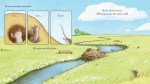
Illustration from Such a Little Mouse. Text copyright 2015 by Alice Schertle. Illustration copyright 2015 Stephanie Yue. Used with permission from Scholastic Press.
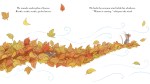
Illustration from Such a Little Mouse. Text copyright 2015 by Alice Schertle. Illustration copyright 2015 Stephanie Yue. Used with permission from Scholastic Press.
The Call of the Open Road
Some people are born to ride, and Stephanie Yue (Such a Little Mouse; The Mousenet Trilogy) has successfully managed to combine her love of scootering with her job of illustrating children’s books. After logging almost 32,000 miles, she’s currently in the last leg of her tour, crossing the continental United States on her electric blue 2009 Vespa GTS 250. During a recent pit stop in Houston, Yue spoke with me about her fascination with mice, martial arts, the siren call of rubber and asphalt, and an enduring admiration of Calvin and Hobbes.
Did your childhood in China influence how you illustrate?
I took Chinese calligraphy classes pretty early on, and that influenced my brushwork. Just understanding how you can express something with a tool like a brush is pretty important.
What kind of illustrators are you drawn to?
I admire Maurice Sendak. I know everyone loves him, but he is pretty great. I’m a fan of Edward Gorey too. He has a house on the Cape that’s now a museum. It’s one of my favorite summer destinations.
On your website, some of your cartoons’ expressions remind me of the characters in Bill Watterson’s Calvin and Hobbes. Did his work influence you?
Absolutely, he’s one of my favorite cartoon artists. I admire him for many things, even beyond his impressive body of work.
Did you read his comics growing up?
Yes, before marathoning Netflix was a thing, marathoning Calvin and Hobbes was my thing. I would go into my dad’s study where he had all the anthologies and collections of Calvin & Hobbes cartoons, and I read them dogeared. I don’t even realize it, I suppose his influence is inherent now. Watterson is not just a fantastic artist, he’s so technically skilled! His brushwork is very subtle. He doesn’t let on how much it takes to make everything work. He can have something as simple as a cartoon tiger next to a dinosaur that’s driving a jet. And how does that work? It does.
You draw lots of mice – can you talk about that?
That’s something from my childhood too. My favorite books were those adorable mouse stories by Kevin Henkes. I liked a lot of mouse-centric stories because it’s the same world but a completely different scale – there’s something going on in the background that big people wouldn’t otherwise notice. I think children can relate to that.
That comes through in your art – in some images it looks like nothing’s going on, but upon closer inspection, there’s a whole world wrought miniature.
Yes, another world running parallel to the human world. It worked great for MouseNet and MouseMobile. I love playing with scale and it’s a fun exercise when I can repurpose human objects for mice. I’ve always been a fan of miniatures.
Do you envision writing your own books?
I’d like to, but I’m not sure if it would be in the same field. I’m a big fan of travel. I’ve actually been traveling for 11 months. I’m working on the road.
Where are you?
I’m in Houston. Central Time Zone. I’ve been in all the time zones.
You’re on your scooter?
Yes.
What are you doing?
I’ve been doing a blog, and I post drawings every day that I ride.
Could you talk about scootering and working on the road?
I take notes as I go. I love notes. I blog and upload my sketches every few days, depending on variables like camp lighting and WiFi. Generally, I’ll find a coffee shop and set up – and draw the images I’ve noted while on the road and post them. It’s a big task I set out for myself.
How long to do you plan on continuing your trek?
The trip is like an extreme four corners trip. I planned on visiting the four outermost points of the 48 contiguous United States. I went to Key West, then up to Angle Inlet, then I went west to Cape Flattery, then I took a side trip down to Baja, then to Colorado, now I’m here. I’m aiming for Lubec, Maine in early July, I think. It’d be nice to see some friends for July 4th.
Are you on your own?
Yes.
What’s that like?
It can be lonely, but it gives me a lot of freedom. A lot of things aligned for this trip to happen. I’m already very used to working by myself – for all of my books, I work from home, I had a second bedroom in Providence converted into a studio and I work by myself and realized that I think I can take this on the road. I managed to pack my whole studio in a little box. If you look on my blog you’ll see photos of the scooter, and on the back there’s a big black box. It’s a Pelican case, shatterproof and waterproof. It works out great. My artwork and my laptop and tablet are in there. That’s my studio. And a thin box, pens and paper. All that goes into a Velcro bag, and then it all goes into that bag.
Is there anything you didn’t bring that you wish you did?
I was really involved in my martial arts group back home, and it’s really hard to do that from the road. I can’t really justify packing that stuff because it takes so much space. I can’t put my boxing gloves on my scooter.
How long have you been practicing martial arts?
About 10 years, all different styles – kung-fu, muay-thai, jiu jitsu. I love that stuff. If you look on my website, that’s how I started getting the mouse work, I made a poster of a mouse demonstrating the 24 steps of tai-chi. It was just a really popular poster.
Have you met people on the road? What’s the scooter/biker community like?
I know a lot of scooterists – I’m familiar with that community, and some of the bikers too. We’re all riders. It’s been a crazy trip.
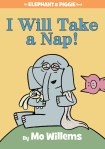
I Will Take A Nap! by Mo Willems; Hyperion Books, $9.99, 64 pages, ages 6-8.
Gerald and Piggie are back in their 23rd adventure of hijinks and adventure. This time, Gerald is cranky and wants to nap, but can’t seem to shake Piggie from his mind. Will he ever catch his forty winks, or will Piggie’s presence distract him? Mo Willems’ award winning early reader series has captivated young readers since 2007, and it’s easy to see why; the books are written comic-book style, with color-coded speech bubbles for each character, and there’s plenty of word repetition for children to practice. Where Elephant and Piggie departs from the Dick and Jane model is word choice – snore and cranky are prominent in this book – and there’s plenty of action to keep readers engaged.
While there are many early readers to choose from, there’s no reason to settle for boring or overtly didactic when writers like Willems are crafting great books like those in this series. I Will Take A Nap! is available everywhere today, June 2.
Midnight: A True Story of Loyalty in World War I, by Mark Greenwood, illustrated by Frané Lessac; Candlewick Press, $16.99, 32 pages, ages 8 and up.
On Halloween Night in 1905, a horse was born on a cattle ranch in New South Wales, Australia. Twelve years later to the day, that horse, appropriately named Midnight, would participate in the Charge at Beersheba, one of the last great cavalry charges in military history, which resulted in the victory that led to the eventual collapse of the Ottoman Empire. Here, award-winning author Mark Greenwood (The Legend of Moondyne Joe; The Greatest Liar on Earth) goes back to his Australian roots by sharing the story of this remarkable mare and her brave owner, Guy Haydon. Greenwood deftly traces the course of Midnight’s life as it changes course from cow horse to member of the Australian Light Horse Brigade, and does such a masterful job of it. This is a story of bravery and sacrifice, and it will bring tears to all who read it. (This is not suitable for bedtime; in addition to its somber tone, the tale will incite discussion and an immediate desire to learn more.) Illustrator Frané Lessac traveled to Be’er Sheva in Israel with Greenwood in order to see firsthand where Guy and Midnight participated in the charge. The trip bore fruit: pigment-saturated gouache illustrations capture the desert sands and blood-red skies of battle. Complete with detailed endnotes and photographs of the real Guy and Midnight, this is a perfect example of history leaping off the pages and into readers’ lives. (Walker Books, Midnight’s Austrailian publisher, put together a wonderful teacher’s guide, which would also be useful for Americans who may be less familiar with this particular part of WWI history.)
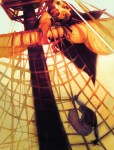
‘One more step, Mr. Hands,’ said I, ‘and I’ll blow your brains out!’ Image from The Folio Society’s Treasure Island, illustrated by Sterling Hundley. Reproduced with permission.
IN THE NEWS: Congratulations to Sterling Hundley, the overall winner of the V&A Illustration Awards. Hundely took home the award for best book
illustration for his artwork in the Folio Society’s edition of Treasure Island. Judges described his work as “richly coloured, atmospheric and stylistically consistent’,‘appropriately sinister’ and‘bold, brave and powerful”. (Read the entire press release here.) The awards ceremony took place on May 18 at the Victoria & Albert Museum.
Learn more about this American artist and his method – my profile on Hundely, appeared on the Fine Books & Collections Blog in January.
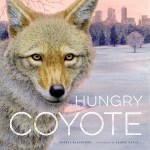
Hungry Coyote, by Cheryl Blackford, illustrations by Laurie Caple; Minnesota Historical Society Press, $16.95, 32 pages, ages 3-7.
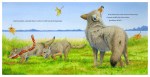
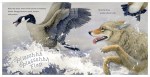
Coyotes are flourishing throughout North America, and have thoroughly adapted to urban environments – New York seems to be a perfect habitat for these nocturnal creatures, but the animals are quite at home in most cities across the country. In Hungry Coyote, Cheryl Blackford details a year in life of a coyote constantly on the prowl for his next meal. He rummages for leftovers from a summer picnic, forages vegetables from a garden, and even procures an old goose to feed his growing family. The writing is crisp and snappy, with just enough detail for young readers. Endnotes explain just how much real estate humans share with coyotes (it’s a lot), as well as why it’s pretty unlikely for a coyote to attack a human. (A Yorkshire Terrier relieving himself in the backyard at midnight, however, is another story.) Laurie Caple’s paintings are expertly rendered with watercolor and pastels, and are a visual treat for nature enthusiasts. Hungry Coyote is a beautiful ode to an often reviled animal, and encourages readers to appreciate (and perhaps enjoy) the fact that such a beast lives among us.
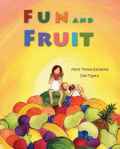
Fun and Fruit, by María Teresa Barahona, translated by Jon Brokenbrow, illustrated by Edie Pijpers; Cuento de Luz, $16.95, 24 pages, ages 5-7.
Charlotte and Claire live in a magical world among thousands of delicious fruit-bearing trees. To pass the time, the girls choose a special color each day, and tell each other stories about their snack before eating the fruits in that hue. And so begins Fun and Fruit, a mouth-watering tale exhorting the benefits of healthy eating. María Teresa Barahona’s text retains its upbeat, bouncy feel in translation (the book was originally published in Spanish as ¡Qué divertido es comer frutas!), but, as happens sometimes with books that veer to the pedantic, some of the tales are more earnest in their message than others. For example, after the girls imagine lemons as clouds, they ask their cousins to fashion an apple-shaped ball to keep soldiers busy at soccer instead of fighting. Other, better, fruity stories inspire the girls to heal the sick and be good friends. Despite a few missteps, Fun and Fruit isn’t overly heavy, and may very well find its place as a tool to help children understand their feelings. Since most Cuento de Luz’s publications are originally in Spanish, some of their titles (like Fun and Fruit) seem like natural fits for language instruction – a peppering of words for colors and fruits would have been perfectly at home in this book.
The art is a feast for the eyes. Dutch artist Edie Pijpers’ paintings are saturated with mouth-watering melons, figs, and coconuts, while her renditions of smiling, caring children are reminiscent of Helen Oxenbury’s full-faced and joyous cherubs.







 Literary Features Syndicate