Edward Gets Messy

egm1
Text copyright 2016 Rita Meade. Art copyright 2016 Olga Stern. Reproduced with permission from Simon & Schuster.

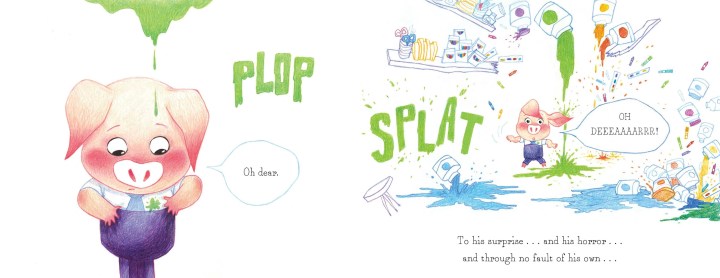
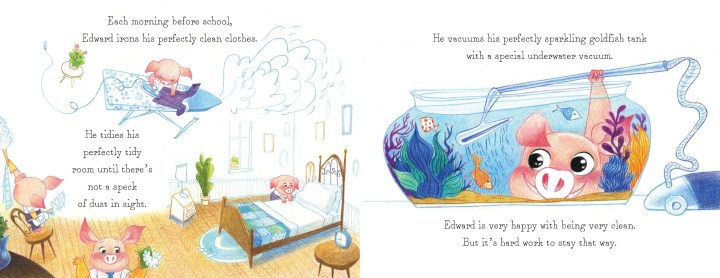
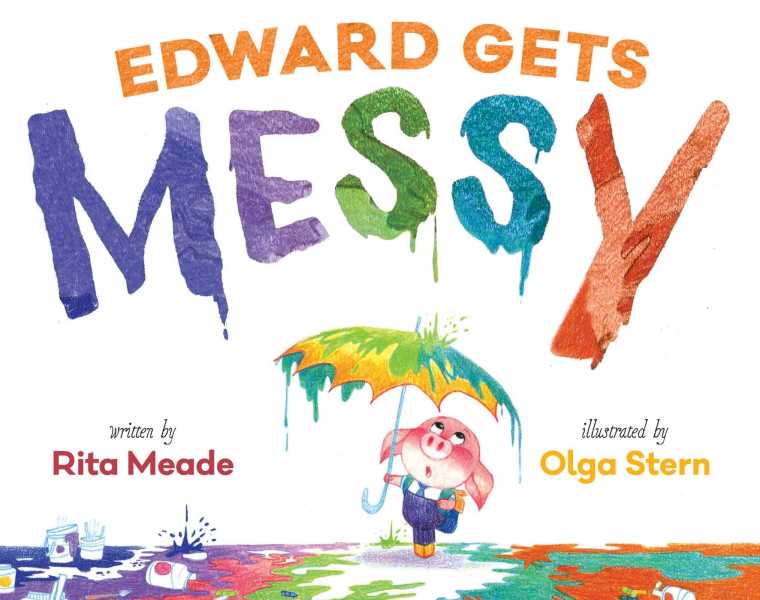
Edward Gets Messy, by Rita Meade, illustrated by Olga Stern; Simon & Schuster Books for Young Readers; $17.99, 32 pages, ages 3-7. 

Edward is a scrupulous pig–he irons his clothes before school, vacuums the fish tank, and avoids leaf piles and volcanic science experiments in order to stay clean. One day, while tidying up the supply shelf in class, green paint plops onto his pressed shirt, the catalyst for Edward to discover the joys of digging in dirt and exploring new activities. Debut children’s book author Rita Meade composes a quick-paced, witty narrative that begs to be read aloud. Olga Stern’s bright colored pencil illustrations build in intensity as Edward’s embrace of chaos grows. Neatniks will sympathize with Edward’s penchant for cleanliness, while ragamuffins will cheer this little piggy on his messy adventure. Besides, sometimes the best part about getting dirty is the clean-up afterwards.

egm3
Text copyright 2016 Rita Meade, art copyright 2016 Olga Stern. Reproduced with permission from Simon & Schuster.

Fairy Tales Transformed

The Singing Bones, by Shaun Tan; Arthur A. Levine, $24.00, 192 pages, ages  14 and up. 

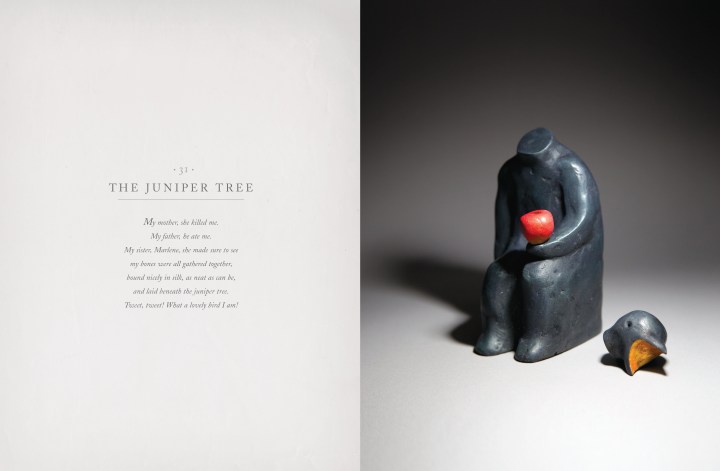
Australian artist Shaun Tan has made his name creating surreal, slightly peculiar works of art with the ultimate goal of encouraging dialogue and social engagement–Tan worked on the science-fiction animated film WALL-E, for example–and in The Singing Bones he tackles the Grimm brothers’ literary canon with similar verve. Seventy-five pieces of original art are accompanied by a portion of text from obscure and beloved tales by Jacob and Wilhelm Grimm. Inspired by Inuit and pre-Columbian stone carvings, Tan’s compositions are molded of earthy, unpretentious materials–papier-mâché and air-drying clay adorned with acrylic paint and shoe polish–resulting in art that looks like it has weathered the passage of time.

Many of the selections may not be well known to contemporary readers, at least not in the forms referenced here: in “Mother Trudy” an overly inquisitive young girl is turned into a block of wood and cast upon the hearth by a witch, and Tan’s sculpture depicts a demonic-looking old creature nestled comfortably in front of a recently lit blaze. A wicked stepmother decapitates her stepson in “The Juniper Tree” and the attending artwork is a disturbingly complex rendering of multiple moments that unfold in the narrative. Snow White and her long-forgotten sister Red Rose gleefully traipse on a magical bear in another excerpt. Though summarized in an annotated index, only the basic sketch of each story is provided, encouraging readers to explore the fairy tales separately.

Reigning master of macabre Neil Gaiman and renowned fairy-tale expert Jack Zipes  provide thoughtful introductions and commentary on the enduring importance of the Grimm fairy tales for our generation.

The Singing Bones is a powerful examination of the range of human emotion, and how much greater that range can be for children, if adults will allow it. 31-juniper-tree9780545946124_interior-101

American Library Association Announces Award Winners

‘Tis the season for award ceremonies, and on Monday the American Library Association (ALA) announced the top books for children and young adults at its Midwinter Meeting, held this year in Atlanta, Georgia. We reported on Tuesday that Kelly Barnhill took top honors with the Newbery; read who else was recognized for their contributions to children’s literature over on the Fine Books Blog.

This Book is Magic!

Hello, World! series author Ashley Evanson is back with This Book is Magic! (Grosset & Dunlap, $14.99 32 pages, ages 0-4) an interactive picture book-board book hybrid for emerging readers. Evanson’s clearly got a knack for getting kids interested in reading and she kindly answered a few of our questions about her craft and the magic of childhood.

Below is an edited transcript of our question and answer session from January 17, 2017.

  1. What was the inspiration for this book?

A couple of years ago my little brother called to ask a few questions about the first Harry Potter book, which I happily answered since I’m a huge fan of the series. The phone calls continued and I decided to read the books along with him so we could call each other every night to chat. Over the next year we read all seven Harry Potter books, Lord of the Rings, and the entire Sherlock Holmes series. I looked forward to our “book club” with great much excitement. These nightly discussions had me constantly thinking about magic, which is why I dedicated my book to my little brother.

  1. Why focus on magic? You have a whimsical, bright style that youngsters gravitate towards.

I think childhood is its own element of magic, and everything in this book is something I imagined as a child or see my own children imagining.

  1. Your Hello, World series is adorable–I have all 4 titles here–do you have plans to add to that series?

I would love to create more Hello, World books! But first I’m publishing a companion book for This Book Is Magic.

  1. What’s your medium?

Everything I do is on Adobe Illustrator.

  1. How do you approach a project? What’s your process?

My approach is pretty primitive. I mean, my rough drafts contain stick figures! The concept always comes first and the art follows, but I only include concepts of things I know I would love to draw. I have inspiration boards of my favorite artists, color palettes, and photographs of the images I’m drawing.

  1. Do you work solely in children’s picture-book illustration? 

I feel like if I tried to illustrate anything else it would still end up looking like a children’s book illustration. It’s just who I am.

  1. Could you tell me how you think your work is helping shape and excite young minds. 

I feel like the most unqualified person to be publishing books so I tell people if I can do it, seriously, anybody can do it!

  1. What are you working on now?

I’m in the brainstorming phase for the companion book to This Book Is Magic, but it feels a little more like the writer’s block phase! I’ll get there!

  1. What else should I have asked you that I didn’t but that you would like our readers to know about you?

My occupation may be an author-illustrator, but my number one job is being a mother. There is nothing more magical or important than childhood and raising your little ones.


Kelly Barnhill Awarded 2017 Newbery Medal

At the American Library Association’s (ALA) midwinter conference yesterday in Atlanta, Minnesota native Kelly Barnhil was awarded the 2017 John Newbery Medal for The Girl Who Drank the Moon (Algonquin Young Readers). Like her 2014 debut The Witch’s Boy, this fantasy coming-of-age fairy tale will no doubt secure itself as a modern classic.

I had the great privilege of speaking with Barnhill back in 2014 about The Witch’s Boy and the importance of magic and danger in children’s literature, which ran here in January 2015. That interview also served as a resource for a story I wrote for the Spring 2015 issue of The Sewanee Review that traces the origins of danger imagery in children’s stories, starting with fairy tales by the Grimm Brothers and moving into the present day. I am grateful  to Gregory Maguire, Mac Barnett, and Kelly Barnhill for their powerful and nuanced thoughts on the importance of their craft for shaping the minds of young readers.

Congratulations to all of yesterday’s winners–check out my Friday column on the Fine Books Blog for a full run-down of the ALA awards.

Inauguration Day, 1861 – The Fine Books Blog

 Inauguration of Abraham Lincoln, March 4, 1861, salt print, by Alexander Gardner, American 1821-1882. Courtesy Bowdoin College Museum of Art.
Inauguration of Abraham Lincoln, March 4, 1861, salt print, by Alexander Gardner, American 1821-1882. Courtesy Bowdoin College Museum of Art.

For folks worrying about today’s inauguration, take heart and consider the first swearing-in ceremony of America’s sixteenth president, Abraham Lincoln. (Read more at: Inauguration Day, 1861 – The Fine Books Blog )

Something for Everyone

The Borrowers Collection, by Mary Norton, illustrated by Beth and Joe Krush; HMHCo, $24.99, 1004 pages, ages 8-11. 

The charming adventures of the miniature Clock family have captivated readers since the Eisenhower era, and this hefty volume presents five fantasy-filled adventures. The first story won the Carnegie medal in 1952, and today The Borrowers remains as magical and rewarding as ever. A captivating gift to share with first-timers and lifelong Borrowers fans.

Muddle & Mo, by Nikki Slade Robinson; Clarion Books, $14.99, 32 pages, ages 0-3. (available February 21, 2017)

muddle.JPG

Originally published in New Zealand,this cuddly picture book by Nikki Slade Robinson  lands stateside in less than a month, and it’s worth putting on your wish list; this adorable story about a goat and a duck exploring what makes them different subtly teaches important life lessons like kindness, patience, and love.

see.JPG

Did You Ever See? by Joanna Walsh; Tate, $16.95, 32 pages, ages 2-5.

Kids wonder about everything–why the sky is blue, what the smallest living creature is, and even what the inner workings of a television look like. Author-illustrator Joanna Walsh examines the world from a youngster’s point of view, and her oversized images of big eyes staring out at the world in bold stamps of color encourage imaginative exploration. Walsh’s jaunty text nicely coordinates with the retro-jam feel of the illustrations. Art lovers of all ages will find something to enjoy here.

Booksellers Consider Constraints of New California Autograph Law; Others Push for Repeal – The Fine Books Blog

Source: Booksellers Consider Constraints of New California Autograph Law; Others Push for Repeal – The Fine Books Blog

Clowning Around with Elisabeth Helland Larsen

In December we reviewed Elisabeth Helland Larsen’s poignant examination of mortality in Life and I: A Story About DeathLarsen kindly answered a few of our questions about her work as a children’s book author and visiting hospital clown to children in critical care units and in refugee camps. (No creepy clowns here!) Larsen lives in Oslo, Norway, and answered our questions through a series of email exchanges at the dawn of January 2017.

LFS: Can you tell me about the I Am series? [Life and I is one in a trilogy of books on the subject.] What prompted you to take on these topics? 

EHL: This series is a result of my meetings with children and youth in various states of emergency over the past twenty years, and I’ve combined my own mix of fantasy and playfulness. For a very long time I’ve circled around the themes of death, life, and clowning. Nearly everything in my life deals with these topics. My aim is not to give any answers but to create conversations, reflections, or visual experiences. I believe the Norwegian publishing house Magikon and all the other countries that have translated the books are quite brave in taking on such a subject. These books wouldn’t be what they are without the talented illustrator Marine Schneider.

LFS: How did you get started as a clown? Do you work with a group?

EHL: I started with theater and clowning when I was very young because it gave me the freedom to do everything I wanted: meet people, travel around the world, and encounter different cultures. Playing, juggling, acrobatics, dancing, drawing–these are universal activities that each culture gives their own slant. After completing theater school in Paris, I became more and more involved in clowning in hospitals and refugee camps. Now I’m part of a group of hospital clowns in Norway called All Noses and I visit refugee kids as often as I can.

clown2

LFS: How do children react when they meet you in clown costume?

EHL: The red nose is like a universal passport into all cultures. It is incredible how laughter and playing can unite us despite different circumstances. The power of love, humor, and playing can help children survive overwhelming odds. Laughter keeps us afloat when life gets tough. I am so amazed to see the power to overcome in every single human being. I’ve only had positive reactions to me in clown character.

LFS: How do you prepare for a clown show? 

EHL: These days I work in hospitals and I also tour a lot to promote my books, which I present through different kinds of performances than the ones I prepare for children in hospitals. I love to meet children and talk about books and big themes, especially taboo themes. Children are open to honest discussion about tough issues, but we need to be willing to have those conversations.

LFS: Where do you find inspiration for your books? 

EHL: As humans we all have hundreds of stories inside our hearts, minds and bodies. Some of us feel the urge and need to write them on paper or transform them into art.

LFS: Has writing grown out of your work as a clown? 

EHL: Writing has always been a important part off my life but in 2011 I became more serious about it after finishing a training program on writing children books at Norsk Barnebokinstitutt [the Norwegian Institute for Children’s Books].

LFS: What else would you like to tell me about your work?

EHL: I think that adults are duty-bound to encourage children to realize that life in today’s world can have meaning, but they need our guidance. I do what I can with my artistic tools, but we all have a responsibility to teach those who will one day lead the world.

Top photo by Christine Crüger. Reproduced with permission from the publisher.
Hawaii’s Written History of Karate Preserved – The Fine Books Blog

Hawaii’s Written History of Karate Preserved

Cover for Kobudo kenpo, karate katsuyo zukai setsumei goshin-jutsu (1952). Reproduced with permission from the Hawaii Karate Museum Collection, the University of Hawaii at Manoa Library.

Source: Hawaii’s Written History of Karate Preserved – The Fine Books Blog