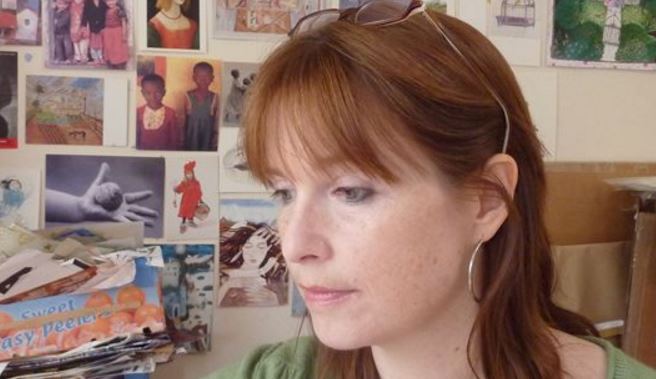
Q&A with Jane Ray

British author-illustrator Jane Ray has over seventy children’s books to her credit, filled with plucky mermaids, fairies, and ghosts, while clever illustrations have earned her a spot on the shortlist for the Kate Greenaway Award five times. Ray was recently nominated for the 2018 Hans Christian Andersen award,  an international prize often referred to as the “Little Nobel Prize.” Ray’s stories hail from all the corners of the world and are receptive to diverse creative influences. Her most recent book, The Elephant’s Garden (Boxer Books, $14.95), deals with hunger, greed, and temptation, but there’s no fire and brimstone here; Ray’s jewel-toned illustrations masterfully weave a beguiling tale set in a fantastical corner of India.

And that’s how it is with most of Ray’s books, wherein a deft master dazzles with lyric prose and illustrations to the point where the reader almost forgets that there’s a moral in there somewhere. Ray credits understanding parents and a lifelong love of reading and drawing for fueling her career. Ray kindly spoke with us via e-mail on March 22, 2017 about her early influences and artistic process, and extolled the virtues of toting sketchpads everywhere, because you never know when inspiration may strike.

You’ve written and illustrated over seventy children’s books, many of which focus on folk tales and fairy tales—your illustrations for Berlie Doherty’s Classic Fairy Tales put you on the shortlist for the Kate Greenaway Medal—what draws you to these stories?

RAY: I think it is the shape of traditional stories that I am attracted to. They are so familiar to us – you just start with “Once upon a time….” and we all know where we are! The archetypal scenarios of kings and princesses, three brothers or sisters, towers and palaces, poverty and wealth seem universal. I guess these stories relate to human concerns the world over – health, wealth, happiness, life and death.

What books did you read growing up? I understand yours was “a house full of books and music” and that you found school a distraction from your true calling. Did your parents encourage you to become an artist?

RAY: I was very lucky to have very encouraging parents – not to be underestimated. Important books were Alice in Wonderland, the Little House on the Prairie books, the Green Knowe Books by Lucy Boston, Tom’s Midnight Garden. I loved the illustrations of Beatrix Potter and Brian Wildsmith, Arthur Rackham and Jan Pienkowski. 

What pulled you to the story of The Elephant’s Garden? Where did you first encounter this story?

RAY: I found the story when I was researching an anthology that I put together for Boxer Books, called The Lion and the Unicorn and other Hairy Tales. It came from a collection of Indian folk tales in my local library. The original story was about an ox and a monk, but I felt an elephant had more appeal, and I wanted a child protagonist. That is the beauty of such stories – they belong to everyone and can be retold in any way, to fit your audience. Nothing is written in stone.

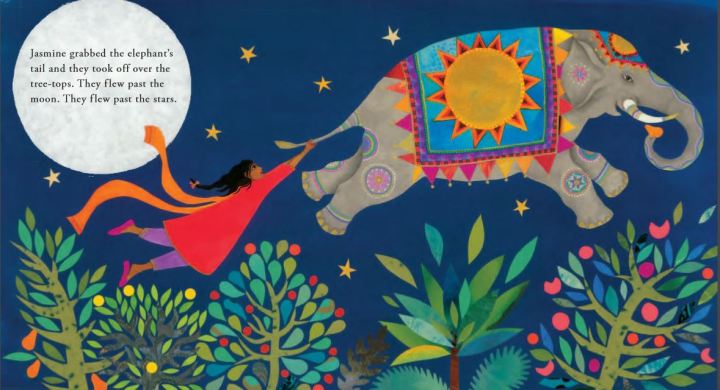
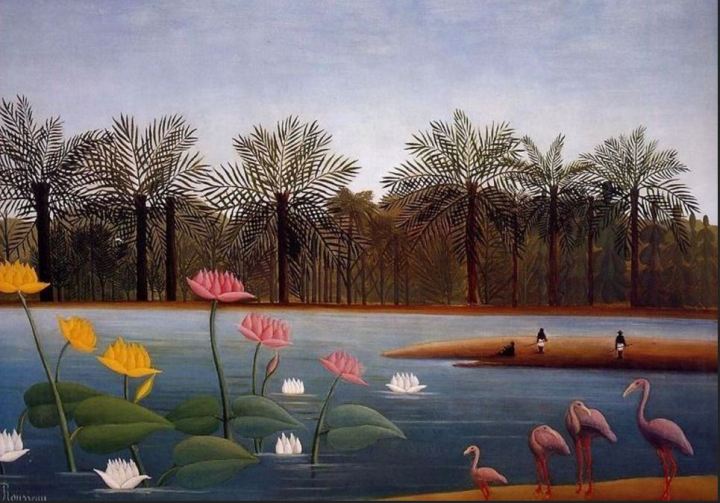
The illustrations for The Elephant’s Garden remind me of various jungle scenes by Henri Rousseau—what influences did you draw upon for this book?
efg1
Text and art copyright 2017 Jane Ray. Reproduced with permission from Boxer Books.

RAY: I had been experimenting with cut paper as a medium – there is a freshness and brightness to the technique which felt right for this story aimed at the very young. It is also a technique common to several different cultural traditions – Polish and Mexican to name but two….and Matisse of course!
flamingos
The Flamingoes by Henri Rousseau


What is your philosophy when it comes to creating a well-crafted children’s book? How do you know when the text and art are in perfect pitch?

RAY: When I’m illustrating my own text, it’s a constant backwards and forwards process of balancing text and image. I always find that the story can be pared down considerably once I start on the pictures – visual action reducing the need for explanation in the text. But you also don’t want to sacrifice the poetry and balance and rhythm of the words – hence the to-ing and fro-ing, trying to find the right balance.

What’s your creative process? Does it vary whether you’re collaborating with an author or working on your own project?

RAY: Yes, very much. When I’m working on someone else’s text I have a ready-made frame work which, by and large, I will adhere to. There can be, hopefully, some give and take between author and illustrator, the author willing to be flexible about issues that arise in the illustration of the text, but ultimately I am always very conscious that I am entrusted with someone’s “baby,” their precious story, and I want them to be happy with my interpretation.

When I am working on my own text, it is a much less defined process, a more organic process, with text and picture developing alongside each other, constantly responsive to each other.

What kind of research do you conduct for your projects?

I’ll do some basic research into historical or national costume, though I’m never too hidebound by this. Similarly, I’ll look at cultural and national ideas to provide background and some sense of the story I’m illustrating and/or writing about. Ideas for books come from so many different places – current events, dreams, ancient stories, poems, conversations with children, my work as Artist-in-Residence at a London center for refugees – and these circumstances all bring their own references and backgrounds which serve as source material for each projects.

How do you create your artwork? What kind of materials do you use?  I understand you used collage for The Elephant’s Garden.

RAY: Yes – I use a lot of collage. I love the variety of texture and pattern that it brings, and also the references – fragments of newsprint for example. I also use watercolor, water color pencils, inks, gouache, and I’ve done a series of books using scratchboard, which looks a bit like engraving. My work is multi-layered – I always have a struggle with providing roughs because so much goes into the actual making process that can’t be shown “in brief.”

I don’t use the computer at all – I just don’t have those skills. I also rather like the physical processes of putting paint on paper.

Could you talk about your work with the Foundling Museum? I read that you were recently working on a picture book for them.

This was a while ago now and was a part of another project, In The Picture, which aimed to get images of disability into children’s books. But the experiences I had at the Foundling Museum fed directly into the novel Heartsong, written by Kevin Crossley Holland, which I illustrated recently. It is set in 18th-century Venice and is about the foundling children at the Ospidale de la Pieta, where Vivaldi was priest and composer and taught promising young girls to sing and play music to astonishing standards.


Do you have any advice for budding artists? So many children enjoy art, then reach seven or eight years old and either love it or decide they’re no good and give it up.

My advice is to get the sketchbook habit – to get into the habit of looking and drawing, to note things down, to collect images and ideas, snippets and fragments that intrigue and delight, or even scare you…In a sketch book you can make mistakes and change your mind, you can turn the page and do it differently – it doesn’t have to be a masterpiece. There is room to discover who you are as an artist and what you like and what makes you tick.

Have there been any projects that didn’t turn out as planned? (For better or worse?)

I always have a vision of how a book is going to be – and it never turns out like that! But that’s half the fun!

How has your work changed over the years?

I have got much more disciplined about producing the art work. I used to let things go that, looking at them later, I regretted. I have got technically more dexterous I think, simply through experience and practice. I am always wary though, of losing freshness and spontaneity – one needs to keep a childlike, open quality in one’s work.

Do you visit schools? What is that like? What kind of questions do children ask?

I often visit schools and find it both stimulating and exhausting! Children ask all sorts of things – from, “How old are you?” to, “How do you think of stories?”

What are you working on now?

A story about a unicorn – a Scottish folk tale.
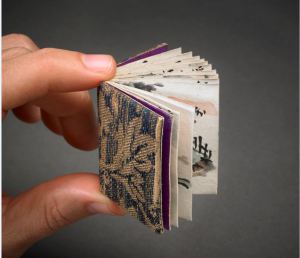
 

“Show Me the Mini” Exhibit at Harn Museum is Full of Tiny Treasures – The Fine Books Blog

 
Source: “Show Me the Mini” Exhibit at Harn Museum is Full of Tiny Treasures – The Fine Books Blog

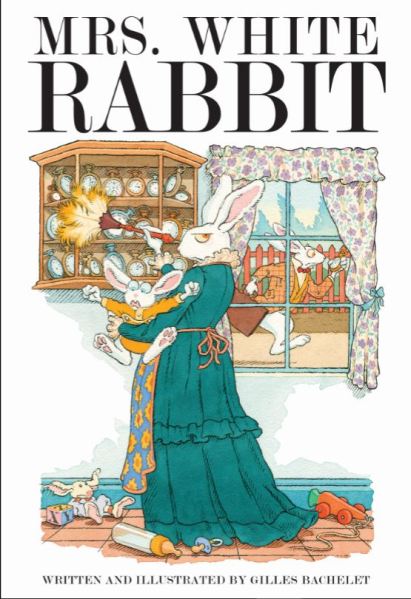
Mrs. White Rabbit

Mrs. White Rabbit, by Gilles Bachelet; Eerdmans, $17.00, 32 pages, ages 6-10. 

rabbit2

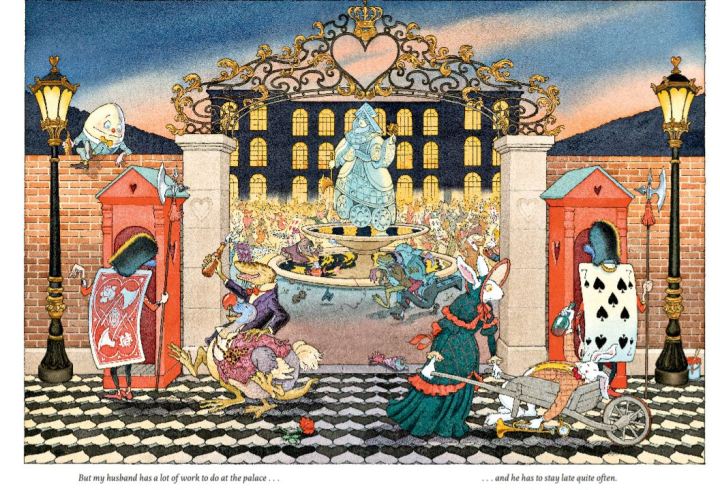
Mrs White Rabbit has her paws full: caring for a household overrun with a warren of rambunctious bunnies, tending to the needs of her time-strapped husband, the White Rabbit, and entertaining the oddball visits of a size-shifting girl named Alice has left the family matriarch feeling sullen, stressed, and neglected. It turns out today is her birthday, and her distracted husband has forgotten all about it. Mrs. White Rabbit vents her daily drama in diary format, giving readers a behind-the-scenes look at life in Wonderland for the White Rabbit’s better half. Gilles Bachelet’s humorous look at leporidine domesticity is accompanied by his equally witty illustrations of bunnies at play, and causing mischief, all under the perennially peeved gaze of Mrs. White Rabbit. Could any family expect tranquility when taking up residence in Wonderland? Besides, it seems all Mrs. W. really wants is a little R-E-S-P-E-C-T, and who can’t relate to that?

Originally published in French as Madame le Lapin Blanc, this cheeky twist on Lewis Carroll’s classic is a quirky reminder that it takes a village to raise a family, and though everyone is busy these days–replace the White Rabbit’s clock with a cell phone and he’d blend in perfectly with any number of daily commuters–we’ve got to make time for our loved ones, too.


Rise of the Centaur: A History of a Typeface – The Fine Books Blog

Source: Rise of the Centaur: A History of a Typeface – The Fine Books Blog


A Tale of Two Roosevelts

My latest review for High Country News examines two books that explore how Theodore and Franklin Roosevelt championed environmental awareness in America, even when it was mighty unpopular to do so: 

The Forbidden Fruit of an Elephant’s Garden

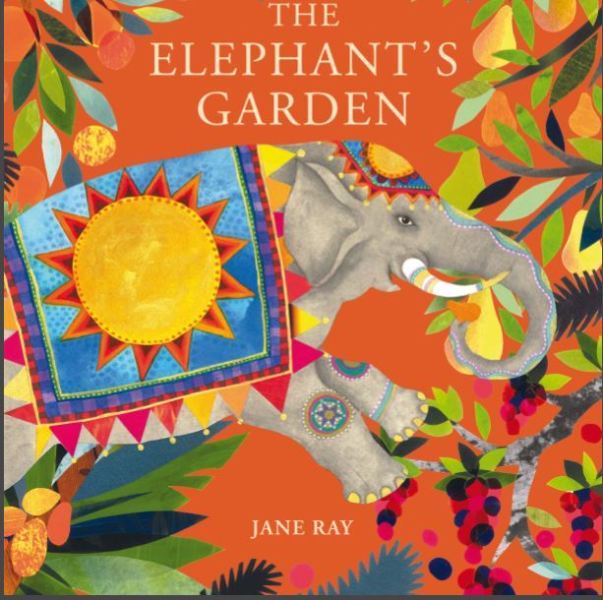
The Elephant’s Garden, by Jane Ray; Boxer Books, $14.95, 32 pages, ages 2-6.

Many cultures have their version of the garden thief story–Russian folklore tells of Tsarevitch Ivan whose golden apples are stolen by the mythical Firebird, and food theft leads to a most unhappy ending in Nankichi Niimi’s powerful Gon, the Little Fox (1932). And of course, there’s the biblical tale of the snake tempting Eve with a forbidden apple in the garden of Eden. These aren’t those effortlessly cheerful happily ever after tales–these are stories of greed, failure, and attempts at redemption, with varying degrees of success, and Jane Ray’s retelling of a traditional Indian folktale follows in that tradition.

Here, a little girl named Jasmine discovers a brightly festooned elephant stealing from her garden, and once confronted, the elephant explains that the fruit in his garden is inedible. To prove it, he whisks the astounded child to his faraway cloud garden, where massive kiwis, strawberries, and peaches fill every corner, but sadly, they’re only precious jewels and of no use to a hungry elephant. Upon returning home, Jasmine tells her family about the magnificent sky garden and though she begs them not to tell anyone, the whole village finds out about the elephant’s treasures. What follows is a surprisingly elegant exploration of greed and selfishness. Ray’s vibrant, jewel-toned, collages evoke a lush Indian fantasy world, and the double-page spread of Jasmine grasping the tail of the elephant recall’s a similar nocturnal flight in Joanne Ryder and Amy Schwartz’s Night Flight or any of Henri Rousseau’s jungle scenes.

A worthy addition to any folktale collection, The Elephant’s Garden subtly invokes Ghandi’s summation on avarice: “Earth provides enough to satisfy every man’s needs, but not every man’s greed.”

efg1
Text and art copyright 2017 Jane Ray. Reproduced with permission from Boxer Books. 


Pretty Birds

Check out this pair of sweet bird books that will have your little chicks peeping with joy:


Jump, Little Wood Ducks, by Marion Dane Bauer, photographs by Stan Tekila, Adventure Publications; $14.95, 32 pages, ages 1-4. 

Wood ducks are perfectly named because they nest in the holes of trees. Though safe from certain predators, freshly hatched ducklings can’t fly yet, and getting out of the nest requires a real leap of faith, since some nests can be thirty feet high. Newbery Honor winner Marion Dane Bauer’s latest children’s book imagines the conversation between a mother wood duck and her anxious chicks as they survey their first real challenge. Nature photographer Stan Tekiela’s high-resolution images of wood ducklings are highly entertaining and encourage in-depth examination.

blue

Blue Penguin, by Petr Horacek, Candlewick Press; 15.99, 32 pages, ages 1-6. 

Petr Horacek has built a career sketching adorable parrots, geese, puffins, and other creatures to great acclaim–the Washington Post even called him “the thinking tot’s Eric Carle” back in 2006 when Silly Suzy Goose first appeared. Here, Blue Penguin feels just like a regular penguin, but the other birds don’t think he belongs and exclude him. Blue Penguin spends his days alone, singing a beautiful melody, until one day a small penguin asks Blue Penguin to teach him the song. Day by day, the duo become friends, and Horacek’s lovely ode to friendship and inclusion is a reminder that what unites us is more than skin-deep.

9780763692513.int.1
BLUE PENGUIN. Copyright 2015 by Petr Horacek. Reproduced by permission of the publisher, Candlewick Press, Somerville, MA on behalf of Walker Books, London.


A Book-Lover’s Guide to St. Patrick’s Day – The Fine Books Blog

Today is St. Patrick’s Day, meaning Irish pubs from Boston to Dublin will be busier than usual and just about everyone will be sporting some sort of good luck charm. However, if the idea of day-drinking and parade-hopping turns you green, there’s still a few ways to let your inner Irish spirit free, even from the comfort of your own library. Check out the bibliophile’s guide to St. Patrick’s Day – The Fine Books Blog

Hope and Happy Endings: a Q&A with Stephanie Greene

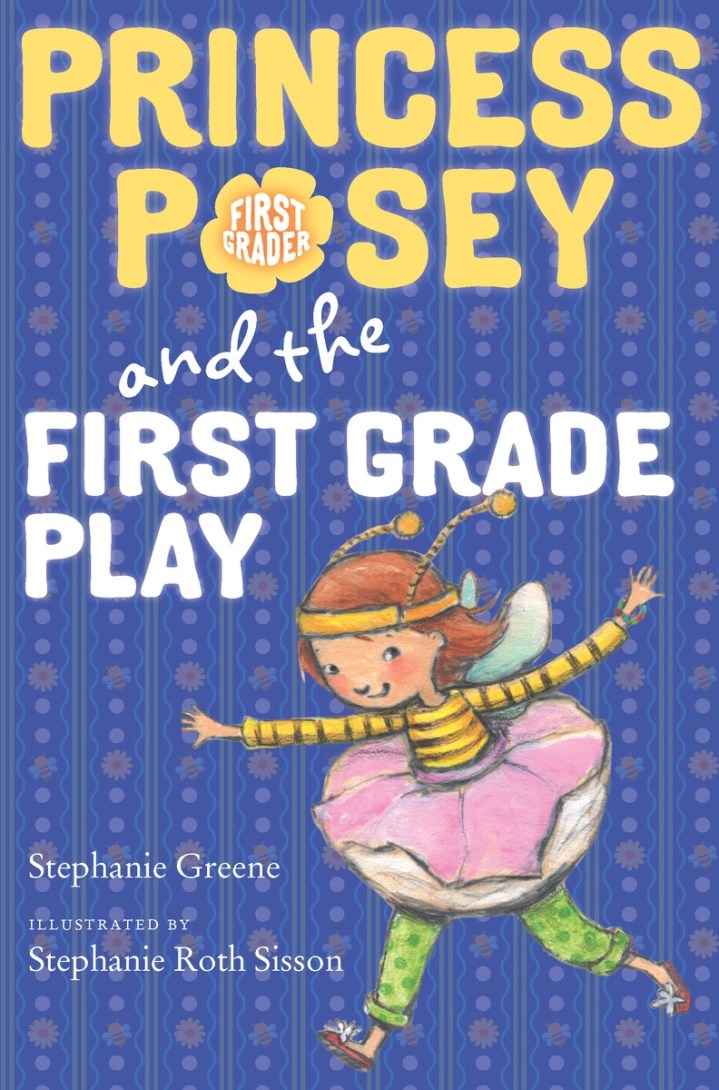
Stephanie Greene’s twenty-year career spans the arc of children’s literature; as the author of over forty early readers, chapter books, and middle-grade novels, and it’s fair to say she’s probably written something that appeals to nearly every young reader. From the Moose & Hildy series to the adventures of Owen Foote, Greene always strikes just the right tone to entice and encourage children to press on and turn the page. Her Princess Posey series has blossomed into eleven volumes, chronicling the adventures of a precocious tutu-wearing first grader as she faces various age-appropriate issues.

Greene’s own childhood was filled with long days spent reading, early tutorials for crafting compelling narratives. Last month, on the eve of the publication of her eleventh Posey book (Princess Posey and the First Grade Play; Putnam) Greene graciously discussed her formative years, the importance of cultivating empathy in children, and her conviction that a child’s imagination must be cultivated and nourished with great books. What follows is a transcript of our e-mail conversation from February 17, 2017.

  1. I read that your childhood influenced your decision to become a children’s book author—could you talk about that?

    I suppose it was the combination of having been the middle child of five, which caused me to pay a lot of attention to all of the family dynamics around me, and the fact that I come from a family of readers. My parents read, my siblings read … we weren’t allowed to watch TV during the week and there weren’t computers yet, so reading was one of our main sources of entertainment. I grew up with, and on, books.
  2. What did you read as a child? Which books were the most memorable? Why?I read everything: Nancy Drew and Louise May Alcott and Frances Hodgson Burnett. The Madeleine books, Barbar, Eloise at the Plaza, old-fashioned books like Little Lord Fauntleroy and Little Women. As I mention these, it feels as if most of the books from my childhood were classics. My all-time favorite was The Secret Garden because I cared about Mary from the start. It taught me about the power of an empathetic protagonist.                                                                                                                                              Princess Posey_cover
  3. Princess Posey and the First Grade Play is the eleventh in the Posey (Congratulations!) How did the series come about? Why did you decide to focus on first grade readers?Thank you. I wrote the first book as a one-off idea after I saw a sign in front of an elementary school that said: KISS AND GO LANE. My immediate reaction was that that could be hard on a child: to have to say good-bye to a parent and walk into the school by herself. I heard a little voice in my head say, “You’re leaving me.” (Seriously, writers do hear those voices – if they’re very lucky.) The original character was called Megan. She wished she could wear her pink tutu to the first day of school because it made her feel like a princess who could go anywhere, and do anything, all by herself. I never dreamt it would become a series. Susan Kochan, my editor at Putnam, saw the potential of Posey’s pink tutu and her feelings about it to act as a hook that could carry a series. It was all her idea. I didn’t decide to focus on first graders. Posey was in first grade and I was focusing on her.
  4. Posey encounters many of the same issues and adventures as children reading the books—is there a real-life inspiration for Posey?Posey is all the little girls I’ve ever known, and also myself, my two sisters, my son’s friends. I raised a boy, so I didn’t have a daughter at home to spy on for material but I didn’t need it.
  5. Why is it so important to teach young readers about kindness and empathy?Empathy is the mortar of life. It’s the basis for a good life for each individual; one in which you care about and try to understand other people. If you can’t do that, and your attentions are only turned inward, you’re leading a pretty paltry existence. Bullies run rampant in such a world. Things fall apart.
  6. What is your work process like? Do you read the book out loud as you go? How do you know when the story is just right?No, I don’t read a book I’m working on out loud. I know it’s right from my gut instinct. Or at least, I know I’ve taken it as far as I can, based on my intentions for it, and will then let my editor determine whether it’s just right. But my instincts are fairly sound.
  7. Do you visit schools? What’s that like? Do you read aloud? What kind of questions do children ask you?I love visiting schools. It’s exhausting, but terrific fun. In today’s world, it’s become more of a necessity to entertain them, which can be tough, but most of the time they’re excited to listen to me because they’ve read my books and like them. The books are the star in any visit. They ask how I write my books, where I get my ideas, which book is my favorite, about my writing habits, how old I am (that’s usually a boy question), if I have pets … they’re interested in a lot of things.

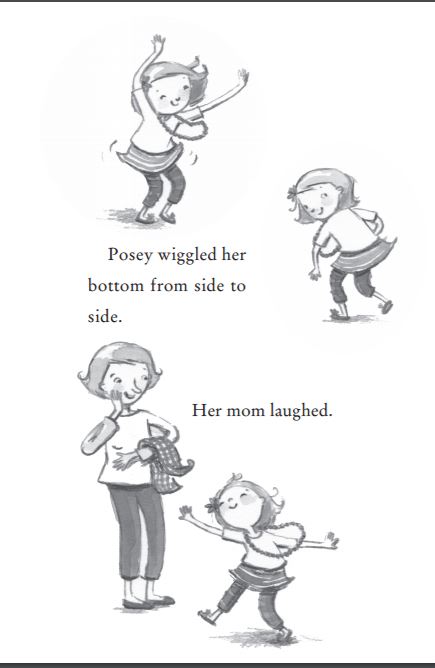
    posey1
    Text copyright 2017 Stephanie Greene, image copyright 2017 Stephanie Roth Sisson. Reproduced with permission from Putnam Books.
  8. Stephanie Roth Sisson’s illustrations are a marvelous match for your text—do you collaborate during the creative process?No. Stephanie and I have never even met. We’ve become friends through emails over the twelve books, but we’ve never discussed a book she’s illustrating. I write the manuscript and once the editor approves it, she sends it to Stephanie, who does her wonderful job with it. I’d love to meet Stephanie in person someday.
  9. Any tips for dealing with reluctant readers?It never fails to amaze me how many parents don’t seem to know what their children are interested in. They like to read about the same things they like to do in life. Ask them what they like to read about. What interests them. What they do at home. What sports they play. Anything, to get some sort of insight into what might interest them in a book. And then, don’t give them books that are too hard for their reading level. And let them read the same book a thousand times, if they want. The patterns of the words and the flow of the sentences are getting into their brains and making the act of reading more familiar.
  10. What are you working on now?A picture book biography about a wonderful physicist of the last century. He made science fun! That’s a message today’s children need to learn. We need scientists.
  11. What do you think is the key to good storytelling?
    Character, pacing, action, conflict, and an ending that satisfies.
  12. What else would you like our readers to know?If they’re teachers and parents, tell them authors love to hear from the children who like their books. If a child gets in touch, I’ll always respond.

Photo of Stephanie Greene by Amy Stern Photography.

Rare Book Week NYC: Navigating the Bazaar – The Fine Books Blog

Book Week has arrived in New York, and there’s plenty to do and little time to do it in. Click through for a few suggestions to help make your Book Week a rousing success:

Source: Rare Book Week NYC: Navigating the Bazaar – The Fine Books Blog